Update: Some personal sources from MN are saying that apparently the death was by overdose. The exact words were "accidental overdose," but just how "accidental" these things are is always hard to pin down one way or the other. Again, though, my speculation below has more to do with what his music represented than the literal truth of whatever happened to him.
I only saw Eyedea perform once, opening for Atmosphere in 2001 or so. I was mostly impressed by the mind-boggling DJ Abilities, who would go on to make one of the definitive contributions to turntablism on Fantastic Damage. If Eyedea was always a little too conventional for my taste, that just shows how far to the edges those tastes tend to run - with his lightning-fast sprints and poetic flights, Eyedea sat right between conventional backpacker rap and the experimental stuff that remains my main jam to this day. He is, though, the first big death out of that cadre of rappers (who would have thought he'd be outlived by Cage?), so today's news really means something to me.
To treat him first as an individual: Though at the moment there's no news about cause of death, I'm willing to bet he killed himself. That kind of speculation may be out of place, but just think about his records. They had a pretty dark vibe overall, from the resentful bitterness of Firstborn to explicit references to overdosing on E and A. And his aggression was always a bit of the Holden Caulfield, angry-at-the-world variety (He was really young, but "Birth of a Fish" from Firstborn exemplifies this). The photos of him with his hair draped over his eyes seemed fully fitting. Some powerful art came out of whatever demons haunted him, but as in all these cases we have to ask whether it was worth it. Even if it turns out he didn't take his own life, those records were probably made by someone who struggled with depression, anxiety, and resentment. Serious artists in the business of looking at society are so often driven at least a little over the edge by the exercise.
But beyond that pure speculation, I wonder whether Eyedea's death can be considered a kind of convenient period at the end of the whole experimental/backpacker scene that flourished in the early part of the 2000s. The only really interesting and relevant records that have come out of that scene recently have been Why?s, and of course those are not rap records. The really good rap records these days have a much less serious vibe than what Eyedea was involved with in his heyday, and it's a shame (with the notable exception recently being Black Milk's Album of the Year). We also lost Rammellzee recently, and if anyone should remind us of the depression, shadow, and weirdness at the heart of hip hop, it was him. Eyedea was a child of Ramm, without question, and the fact that they went pretty close together is . . . well, Eyedea himself would probably say it was a coincidence in a cold and uncaring universe, while Ramm is probably on high doing the numerology of their respective end dates right now.
For whatever reason, and as harsh as it may sound, Eyedea died as the style he worked hard to champion was at a low ebb. Or is it? The same energy, and the same hype, is now surrounding weirdo R&B groups like Twin Shadow and How to Dress Well, who crack open the shiny, often upbeat core of R. Kelly Songs and George Michael crooning to find the darkness and even dread within. And you'll notice one thing - on balance, the artists making the cleaner, more commercialized versions of both hip hop and R&B tend to be black, while the people deconstructing those genres and making them more difficult tend to be white (yes, that's a generalization. Sorry). I think part of it is that more white artists have the ability to let their art live at the relative margins, while a lot of black artists feel the drive to hit the very top of the industry, and are willing to clean up what they're really feeling. As crazy as this sounds, what artists like Eyedea were doing was, at least in part, rescuing the really dark, painful, even twisted roots of black music - the pain of being black in America - from the cleaning up, or on the other hand hyperexaggeration, it often got from the music industry.
So, that's my overthought exploitation of a real man's very sad death. If your life's work is to interpret America - and if you're a rapper, that's your job description - and you take it seriously, you will confront darkness at every turn. Eyedea did that for us, so spend some time enjoying his work and considering the depths that it came from.
Sunday, October 17, 2010
Thursday, October 14, 2010
Tokyo Journal 2: Hobbyist Nation
For a minute last night I thought there was some sort of brutal brawl going down in the park down the street from me. As I got closer, I realized it was just several pairs of young men working on their (typically loud and mock-violent) comedy routines. Everywhere you go, there are people playing saxophone in bicycle parking lots or doing karate on side streets. For such a cramped place, they make the most of it.
Wednesday, October 13, 2010
Japanese Horror-Ween 2: Fuyuko Matsui
Note: I'm now blogging at Blownhorizonz.com. It's more attractive, and it focuses more on cool stuff like noisey music, weird art, and fiction. Check it out!
Fuyuko Matsui
(or, in Japanese, Matsui Fuyuko) is a young and fast-rising Japanese artist who produces images that are both explicitly gruesome in a very modern way, and moody, dark, and subtle in the tradition of a certain kind of Japanese ghost story. She is known almost as much for being beautiful and putting a lot of work into self-presentation as she is as an artist - she shows up on the cover of magazines much as would actresses in the U.S. Naturally, her fame is based on drawings of ghost dogs ripping the living flesh from screaming women:
To see even more, including undead snakes, for chrissakes, try her official site as well as this strangely meticulous livejournal entry (do people still use that?).
I'm really of two minds on Matsui. As a genre fan, her work is mind-blowing - it's smart, meticulous, titillating, and disgusting. It takes you to another world just as effectively as the work of people like Rom Villaseran or Brecht Vandenbrouke (see, you learned about THREE artists today!). But I think that ultimately it's genre work, not Art with a capital DEEP, and the idea that she's some kind of celebrity is a little disquieting. I don't gather that she's really of the Andy Warhol/Lady Gaga school, where her fame is somehow meta-commentary, and it seems unlikely that such gruesome work would form the foundation for fame if she wasn't also a pretty lady. But nonetheless - this is some great work for those of us with morbid minds.
Fuyuko Matsui
To see even more, including undead snakes, for chrissakes, try her official site as well as this strangely meticulous livejournal entry (do people still use that?).
I'm really of two minds on Matsui. As a genre fan, her work is mind-blowing - it's smart, meticulous, titillating, and disgusting. It takes you to another world just as effectively as the work of people like Rom Villaseran or Brecht Vandenbrouke (see, you learned about THREE artists today!). But I think that ultimately it's genre work, not Art with a capital DEEP, and the idea that she's some kind of celebrity is a little disquieting. I don't gather that she's really of the Andy Warhol/Lady Gaga school, where her fame is somehow meta-commentary, and it seems unlikely that such gruesome work would form the foundation for fame if she wasn't also a pretty lady. But nonetheless - this is some great work for those of us with morbid minds.
Sunday, October 10, 2010
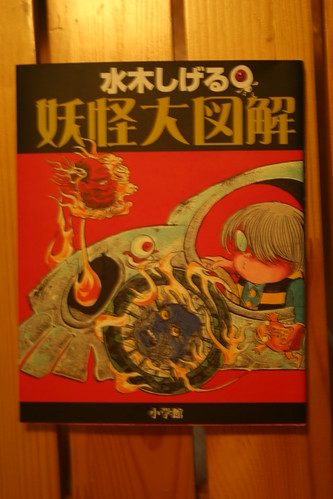
Yokai Autopsy! Shigeru Mizuki makes every day Halloween.
Do they know it's Halloween in Japan? You're god damn right they do. Though it doesn't seem as out of control as things tend to be in the States, there are displays of conventional Halloween goods in most every housewares store, and even better, bookstores are featuring the work of Japan's spookiest manga-ka, Shigeru Mizuki. Mizuki might be the most famous manga artist to remain largely unknown in the states - his Gegege no Kitaro has been made into anime every year since it appeared in 1959, and I there's a new live-action film coming out soon (if you've ever complained about constant remakes in the U.S., be thankful you're not Japanese).
Gegege is the story of a ghost-boy who works to defend humans from yokai, traditional Japanese ghosts, goblins, and demons. I've never actually read Gegege, but I found something even better.
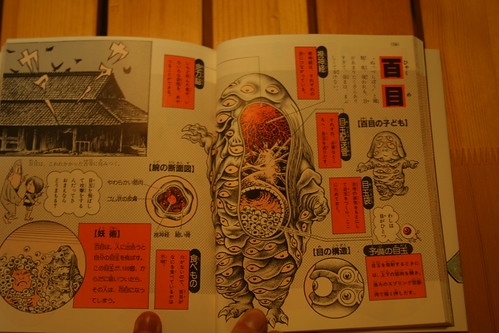
The publisher's blurb describes it as a book of "Monster Autopsies," which is exactly what it sounds like - diagrams of internal organs and natural weapons of yokai, along with descriptions of their abilities.

There's no way I was passing this up - there's nothing I love more than a fantasy bestiary. I haven't played Dungeons and Dragons since I was 13, but I could still sit for hours reading through the Monster Manual. And Barlowe's Guide to Extra-Terrestrials was a completely mind-altering experience for me as a kid. There's just something about getting technical with fantastic creatures, providing plausible explanations for their freakiness, that really does it for me. And the yokai Mizuki chronicles are genuinely freaky.
Gegege is the story of a ghost-boy who works to defend humans from yokai, traditional Japanese ghosts, goblins, and demons. I've never actually read Gegege, but I found something even better.
The publisher's blurb describes it as a book of "Monster Autopsies," which is exactly what it sounds like - diagrams of internal organs and natural weapons of yokai, along with descriptions of their abilities.

There's no way I was passing this up - there's nothing I love more than a fantasy bestiary. I haven't played Dungeons and Dragons since I was 13, but I could still sit for hours reading through the Monster Manual. And Barlowe's Guide to Extra-Terrestrials was a completely mind-altering experience for me as a kid. There's just something about getting technical with fantastic creatures, providing plausible explanations for their freakiness, that really does it for me. And the yokai Mizuki chronicles are genuinely freaky.
Friday, October 8, 2010
Japan's Lost Decade through Economic vs. Culture-Tinted Lenses
I recently found the very interesting New Deal 2.0 blog, thanks to this post by Marshall Auerback. I find the content in itself - mostly an overview of recent Japanese monetary policy - fairly interesting. But what really intrigues me is that this is billed as "What Happened to Japan" - that is, a kind of definitive statement of the last 20-odd years of disappointment. Auerback provides enough economic data to make this a convincing claim, at least for a blog post - but only if you accept the centrality of central banking to macroeconomics.
I, of course, have a tendency to see things in a different light. I don't have ready to hand the stats that would back my assessment up (disdain for math being essential to my intellectual identity), but the ideas that surface again and again when I talk to Japanese people or read about the situation is that the economy has been crippled as much by cultural problems as economic policy. Paramount among these is the inflexibility of the Japanese labor market, especially for educated young people. I spoke last night to a guy in his mid-40s who lamented the fate of Japanese now entering their thirties, who had had the bad luck to graduate from college at a low point among low points. I cited to him some statistics I'd heard recently saying things were rough for low-ebb graduates in the States, too, who needed 20 years on average to match the earning power of those lucky enough to graduate at high tide.
"Well, that would be great!" he marvelled. "In Japan, if you get stuck on that lower rung, there's no way out, at all." He described what he saw as the lingering power of privilege and luck, rather than skill and performance over time, in determining who was hired and retained by prestigious Japanese firms. As years go by, the sometimes ineffective, entrenched workers, who are keeping jobs from potentially more skilled or educated people continuing their part-time work as convenience store clerks, weaken their companies from within. He also described the lack of immigration keeping educated and talented Japanese in "3D" jobs - Dangerous, Dirty, and Dull . . . though interestingly he sort of couched this as a good aspect of a low-immigration and egalitarian society. This is not to mention, of course, the persistent love of Japanese corporate culture towards inefficient overwork for show.
Like I said, I don't have empirical evidence to back up these claims, except to the degree that my conversations with Japanese workers are that. It's at least a widely spread perception, though, that Japanese corporate culture, and the system of social sorting more generally, is broken. Now, everyone hates their jobs, I know, but the real clincher here is that the people I talk to are eager to move to the U.S. because they perceive both work and daily life there are easier - and these are people who have lived in the U.S. and seen its complexity up close, and are well aware of the problems of social inequality.
I don't mean to suggest Auerback is wrong - I know enough economic history to grant the importance of central bank policy. I just think it's interesting to compare my drastically different perspective.
I, of course, have a tendency to see things in a different light. I don't have ready to hand the stats that would back my assessment up (disdain for math being essential to my intellectual identity), but the ideas that surface again and again when I talk to Japanese people or read about the situation is that the economy has been crippled as much by cultural problems as economic policy. Paramount among these is the inflexibility of the Japanese labor market, especially for educated young people. I spoke last night to a guy in his mid-40s who lamented the fate of Japanese now entering their thirties, who had had the bad luck to graduate from college at a low point among low points. I cited to him some statistics I'd heard recently saying things were rough for low-ebb graduates in the States, too, who needed 20 years on average to match the earning power of those lucky enough to graduate at high tide.
"Well, that would be great!" he marvelled. "In Japan, if you get stuck on that lower rung, there's no way out, at all." He described what he saw as the lingering power of privilege and luck, rather than skill and performance over time, in determining who was hired and retained by prestigious Japanese firms. As years go by, the sometimes ineffective, entrenched workers, who are keeping jobs from potentially more skilled or educated people continuing their part-time work as convenience store clerks, weaken their companies from within. He also described the lack of immigration keeping educated and talented Japanese in "3D" jobs - Dangerous, Dirty, and Dull . . . though interestingly he sort of couched this as a good aspect of a low-immigration and egalitarian society. This is not to mention, of course, the persistent love of Japanese corporate culture towards inefficient overwork for show.
Like I said, I don't have empirical evidence to back up these claims, except to the degree that my conversations with Japanese workers are that. It's at least a widely spread perception, though, that Japanese corporate culture, and the system of social sorting more generally, is broken. Now, everyone hates their jobs, I know, but the real clincher here is that the people I talk to are eager to move to the U.S. because they perceive both work and daily life there are easier - and these are people who have lived in the U.S. and seen its complexity up close, and are well aware of the problems of social inequality.
I don't mean to suggest Auerback is wrong - I know enough economic history to grant the importance of central bank policy. I just think it's interesting to compare my drastically different perspective.
Wednesday, October 6, 2010
International Transport Vol. 1: Slowly Summoning the Motivation to Kill Yourself Quickly
Two things have happened to me recently. I've moved to Japan, and my interest in music has returned to just about the highest level since I was an undergrad. I think it's the removal of the pressure of school - I can actually have feelings again. So, in celebration of my return to the world of semi-normalcy, I'm planning on putting together occasional mixes - specifically, for the purpose of showcasing Western underground music to my Japanese friends, and in turn, Japanese music to my Western friends. The first one runs from West to East . . . or actually, from East to . . . wow, these geographical labels really don't work well. Anyway, it's a collection of dubstep, electro-pop, and fuzzy post-soul, all of it cold, melancholy, or some combination of the two.
In Japanese, very roughly:国際通商、第一目:自殺教育
Minds Like Knives, International Transport Volume 1
Tracklist次に。
In Japanese, very roughly:国際通商、第一目:自殺教育
Minds Like Knives, International Transport Volume 1
Tracklist次に。
Tuesday, October 5, 2010
The Banality of Creativity
Yesterday, I went to the first day of classes at Geidai, my new institutional home. My role there is strangely liminal - as a 'researcher,' I have none of the responsibilities of a faculty member, but also none of the authority. I attended the first meeting of my sponsor's graduate seminar, and will probably sit in on it again, because getting used to the flow of ideas in Japanese is one of my main goals here. I do worry about being mistaken, implicitly or explicitly, for a student, and I'm thinking I can remedy that in a way I enjoy - by indulging in new clothes with a patina of authority.
But some of the graduate students - a lot of whom are just first-year Master's students - already seem to be looking up to me as at least a source of advice, if not exactly expertise. I enjoy it, but of course I don't entirely believe my own hype, either. It was less than five months ago that I was putting the finishing touches on the final deposit of my dissertation, and it would be self-serving to pretend I've really figured out either the intellectual or professional dimensions of academia.
In fact, I just went through a pretty surprising first, putting the final copy edits on a journal article that will be coming out, it seems, pretty soon. What surprised me was, like most things that are surprising, something that in retrospect seems obvious - at the end of months (years!) of careful research, reading and soul-searching about the Profound Message of an essay like this, there comes a long stretch of much less scintillating work of fine editing, things like getting your citations to match the journal's style sheet. There are plenty of banalities here, things that bring the grand gesture down - for instance, my article begins with an epigraph from Moby Dick, but my copy editor politely reminded me that I needed to give the book an entry in my Works Cited. Ditto for an offhand reference to Richardson's Pamela, and a passage where I compare the BPMs of a few hit rap songs (yes, I hope you're intrigued).
On the one hand, this is sort of deflating, if not quite humbling. By God, these are big ideas, why should I be bothered with such petty details? I wonder if Marx ever had to fix his italics.
On the other hand, though, it's productively gratifying to see how much work other people are putting into polishing my small contribution. All of these fixes, after all, are coming from editorial staff who are actually getting paid to find all the little details. For all my bigger problems with the academic publishing industry, to have it serving you, at least to some extent, really reminds you that what you've produced has enough value to be made precisely correct.
The dissertation process, which I'm remembering now as I go back through and start revising and reconsidering my project thus far, has a lot of the same elements - details of formatting are almost legendary. But the journal process is even more intense, and I'm assured that putting a book together is even more of an exercise in fingernail-pulling. It's a bit of a wakeup call, and I lay at least some blame on ten years worth of undergrad and graduate instructors who never gave even lip service to this level of precision. But of course, these are small potatoes, and I'm sure jumping all these hurdles will be totally worth it when I see my work in prestigious print. Still - grad school probably didn't prepare you for this, kids.
But some of the graduate students - a lot of whom are just first-year Master's students - already seem to be looking up to me as at least a source of advice, if not exactly expertise. I enjoy it, but of course I don't entirely believe my own hype, either. It was less than five months ago that I was putting the finishing touches on the final deposit of my dissertation, and it would be self-serving to pretend I've really figured out either the intellectual or professional dimensions of academia.
In fact, I just went through a pretty surprising first, putting the final copy edits on a journal article that will be coming out, it seems, pretty soon. What surprised me was, like most things that are surprising, something that in retrospect seems obvious - at the end of months (years!) of careful research, reading and soul-searching about the Profound Message of an essay like this, there comes a long stretch of much less scintillating work of fine editing, things like getting your citations to match the journal's style sheet. There are plenty of banalities here, things that bring the grand gesture down - for instance, my article begins with an epigraph from Moby Dick, but my copy editor politely reminded me that I needed to give the book an entry in my Works Cited. Ditto for an offhand reference to Richardson's Pamela, and a passage where I compare the BPMs of a few hit rap songs (yes, I hope you're intrigued).
On the one hand, this is sort of deflating, if not quite humbling. By God, these are big ideas, why should I be bothered with such petty details? I wonder if Marx ever had to fix his italics.
On the other hand, though, it's productively gratifying to see how much work other people are putting into polishing my small contribution. All of these fixes, after all, are coming from editorial staff who are actually getting paid to find all the little details. For all my bigger problems with the academic publishing industry, to have it serving you, at least to some extent, really reminds you that what you've produced has enough value to be made precisely correct.
The dissertation process, which I'm remembering now as I go back through and start revising and reconsidering my project thus far, has a lot of the same elements - details of formatting are almost legendary. But the journal process is even more intense, and I'm assured that putting a book together is even more of an exercise in fingernail-pulling. It's a bit of a wakeup call, and I lay at least some blame on ten years worth of undergrad and graduate instructors who never gave even lip service to this level of precision. But of course, these are small potatoes, and I'm sure jumping all these hurdles will be totally worth it when I see my work in prestigious print. Still - grad school probably didn't prepare you for this, kids.
Subscribe to:
Posts (Atom)