Great article at Japan Focus from the enduring Noriko Manabe. Dengaryu's album is titled "B Kyuu Eiga no you ni," which means "Like a B Movie." So, that's a big point in his favor already.
Video with subtitles:
Showing posts with label japan. Show all posts
Showing posts with label japan. Show all posts
Monday, February 4, 2013

Tuesday, September 18, 2012
The Manchurian Incident and the Alien Act
Eighty-one years ago today, a Japanese Lieutenant set a dynamite charge on the tracks of a Japanese-controlled railway in Manchuria, in Northern China. The act, blamed on the Chinese, was a successful attempt to initiate sino-Japanese war by the Japanese Kwantung Army. The army had to an extent gone rogue, engaging in militant acts intended to provoke a Chinese response, and was about to be disciplined by the leadership from Tokyo when it chose to take matters into its own hands by manufacturing Chinese resistance. This is known as the Manchurian Incident or the Mukden Incident. What followed was more than a decade of Japanese occupation of and violence against China, including the most brutal single incident in all of World War II, the Rape of Nanking.
Note that I say Nanking was singular in its brutality, not in the number of people it killed. The statistical honors might go to the Holocaust of eastern European Jewry, or to the atomic bombs dropped on Japan by the United States, or maybe even to the firebombing of Dresden by the English. What's remarkable about Nanking, and what it shares with the Mukden incident that paved the way for it, is the completely uncontrolled and undisciplined nature of Japanese military action.
Perhaps this is the real threat Mukden and Nanking hold for Japanese popular imagination, the reason there has yet to be a collective national reconciliation with the legacy of the war, nearly a full century and several generations later - a phenomenon whose very narrow manifestations in popular music I've documented. Perhaps it's not the evil of these acts that's so threatening, but the fact that they are out of character. Certainly, the Germans killed all those Jews, but they did it with a characteristic German efficiency that can be recouped - they may have done something wrong, but they were still German.
Japan's war crimes, though, defied every treasured stereotype of Japanese unity, the concepts so often propagated, not just in the West but within Japan itself, of a 'hive-like' 'oriental' mentality, of collectivism, self-sacrifice, and humility. In Mukden, low-ranking officers took it up on themselves to undermine the plans of their leaders, including implicitly the Emperor. In Nanking, enlisted men ran wild, raping, pillaging, and murdering in endlessly creative ways. These were not strong Japanese collective actions gone awry - they were actions deriving from some other root, something alien and awry, something that, whether deeply human or deeply perverse, were surely not 'Japanese.' They cannot be recouped, explained, or folded into a narrative of evolution. For those who believe in the uniqueness of the Japanese spirit, they can only be denied, repressed, dismissed.
Note that I say Nanking was singular in its brutality, not in the number of people it killed. The statistical honors might go to the Holocaust of eastern European Jewry, or to the atomic bombs dropped on Japan by the United States, or maybe even to the firebombing of Dresden by the English. What's remarkable about Nanking, and what it shares with the Mukden incident that paved the way for it, is the completely uncontrolled and undisciplined nature of Japanese military action.
Perhaps this is the real threat Mukden and Nanking hold for Japanese popular imagination, the reason there has yet to be a collective national reconciliation with the legacy of the war, nearly a full century and several generations later - a phenomenon whose very narrow manifestations in popular music I've documented. Perhaps it's not the evil of these acts that's so threatening, but the fact that they are out of character. Certainly, the Germans killed all those Jews, but they did it with a characteristic German efficiency that can be recouped - they may have done something wrong, but they were still German.
Japan's war crimes, though, defied every treasured stereotype of Japanese unity, the concepts so often propagated, not just in the West but within Japan itself, of a 'hive-like' 'oriental' mentality, of collectivism, self-sacrifice, and humility. In Mukden, low-ranking officers took it up on themselves to undermine the plans of their leaders, including implicitly the Emperor. In Nanking, enlisted men ran wild, raping, pillaging, and murdering in endlessly creative ways. These were not strong Japanese collective actions gone awry - they were actions deriving from some other root, something alien and awry, something that, whether deeply human or deeply perverse, were surely not 'Japanese.' They cannot be recouped, explained, or folded into a narrative of evolution. For those who believe in the uniqueness of the Japanese spirit, they can only be denied, repressed, dismissed.
Wednesday, July 25, 2012
Noriko Manabe on Antinuclear Music
A fresh article from Princeton-based Japanese ethnomusicologist Noriko Manabe, who here describes the No Nukes 2012 concert hosted by Ryuichi Sakamoto. There are some snippets in there about artists' careers being destroyed because they have spoken out against nuclear energy, which are shocking for me even knowing what I know about just how controlled and corrupt the Japanese entertainment industry is.
Monday, July 16, 2012
Was Fukushima Caused by "Japanese Culture"?
The official Diet-commissioned report on the Fukushima disaster was released about a week or so, and a fascinating catch was made by one Richard Katz on the Social Science Japan mailing list. The report is mostly a very specific account of communication failures and lapses in responsibility, but it seems that the English-language version of the report's executive summary lades on some generalizations condemning the root cause of the disaster as Japanese culture itself:
"[The disaster's] fundamental causes are to be found in the ingrained conventions of Japanese culture: our reflexive obedience; our reluctance to question authority; our devotion to 'sticking with the program'; our groupism; and our insularity."
Katz and others have focused on the discrepancy between the English and Japanese versions of the report, with the reasonable assumption that the English version is specifically conceived as playing to foreign expectations. But I'm more interested in the fundamental questions raised by the mere idea: how do these claims seem to define "Japanese culture," its limits and boundaries relative to other spheres of culture, and the way culture affects individual behavior? The points made above seem focused on very local interpersonal behavior, relative to, say, a boss. This is an important distinction from, for example, 'culture' in the more mediated sense, where it may be more difficult to make an argument for any such thing as a uniquely Japanese culture in an era of globalization.
Relevant sources at:
Asahi Shimbun
National Diet of Japan
Asia-Pacific Research Center, Stanford
"[The disaster's] fundamental causes are to be found in the ingrained conventions of Japanese culture: our reflexive obedience; our reluctance to question authority; our devotion to 'sticking with the program'; our groupism; and our insularity."
Katz and others have focused on the discrepancy between the English and Japanese versions of the report, with the reasonable assumption that the English version is specifically conceived as playing to foreign expectations. But I'm more interested in the fundamental questions raised by the mere idea: how do these claims seem to define "Japanese culture," its limits and boundaries relative to other spheres of culture, and the way culture affects individual behavior? The points made above seem focused on very local interpersonal behavior, relative to, say, a boss. This is an important distinction from, for example, 'culture' in the more mediated sense, where it may be more difficult to make an argument for any such thing as a uniquely Japanese culture in an era of globalization.
Relevant sources at:
Asahi Shimbun
National Diet of Japan
Asia-Pacific Research Center, Stanford
Monday, May 7, 2012
Video: Anarchism and Japan's Anti-Nuclear Movement
Here's the video of my recent presentation at New College of Florida's All Power to the Imagination conference in Sarasota, FL. It was a great experience, with a small but attentive audience of anarchist activists and (mostly) theorists. It's an annual event, and I highly recommend that you make the trip next year if you're at all interested.
Thursday, March 22, 2012
SXSW Post-Op: Sapphire Slows
I discovered a few great new bands and made a few great new friends at SXSW this year, and sometimes they were the SAME PEOPLE. For example in this case - Sapphire Slows puts on an awesome show and makes awesome music and also simply is awesome, for good measure. She played the Not Not Fun house party at Hounds of Love, and also the fantastic Impose magazine party at the Longbranch.
Monday, March 12, 2012
Post-Fukushima Japan: Civil Society Rising
A quick writeup here from Daniel P. Aldritch, which is light on specifics but with a good overview of recent substantial shifts in the role of civil society in Japan. For decades, sociologists and political scientists mourned the seeming near-absence of a civil society in Japan, but that has, at least for the moment, all changed.
Thursday, July 14, 2011
James Blake in Japan: How to Import An Enigma
Update 7/24/2011: A friend told me that the Tokyo radio station J-Wave plays James Blake "all the time." They did, at least at one point - "Limit to your Love" peaked at 47 on the Tokio Hot 100 back in February.
A friend just let me know about the fantastic and fascinating article "Japan in Japan: Notes on an Aspect of the Popular Music Record Industry in Japan," by Toru Mitsui (Popular Music, Vol. 3, Producers and Markets (1983), pp. 107-120). It's a detailed and well-informed description of, first, Japanese labels' practices in the late 1970s and early 1980s with regards to the import of foreign records, and second, of the popularity of the English band Japan in the early 1980s. Though of course not quite current, it's a great window into the subtle processes that can dictate how culture travels between modern societies.
What Mitsui primarily focuses on is the fact that by the 1970s, bidding wars between Japanese labels had made artists already well-known in the West progressively less profitable as higher and higher royalties and advances were promised. This led to Japanese labels more aggressively scouting unknown international talent, who still held a broad appeal for the Japanese market. Particularly interesting to me is that Japan were essentially an art-rock band, but they managed to attract a teenybopper audience in Japan because of their heavily made-up, androgynous image. This audience supported them through three early albums that didn't sell particularly well in England or America. David Sylvian, once a member of Japan, is now one of the leading avant-garde musicians in the West, a position he might not have achieved without the financial support of the Japanese market.
Cases of bands not popular in their home turf succeeding wildly in Japan are so common they've become a cliche. Mitsui cites the early success of Kiss in Japan, and the paradigm case is the band Mr. Big, who are essentially unknown in the West but still tour incessantly in Japan.
More recently, there's the case of James Blake. My general impression is that while he's become quite well known in the U.K., he's definitely a niche product in the U.S., pushed by fringe indie websites like Pitchfork and Gorilla vs. Bear. In Japan, while still not a star, his extremely bleak and fairly abstract album has reached the 70th spot on the Oricon album charts since its release about six weeks ago (I'm really wishing I had a full Oricon subscription right now). According to an interview with Ele-King, his import singles were selling out back in February, the kind of thing that builds great buzz for a domestic release. That qualifies him to represent a sort of indie/underground version of the more thoroughly dominant, but also clearly more straightforwardly marketable, likes of Kiss and Mr. Big.
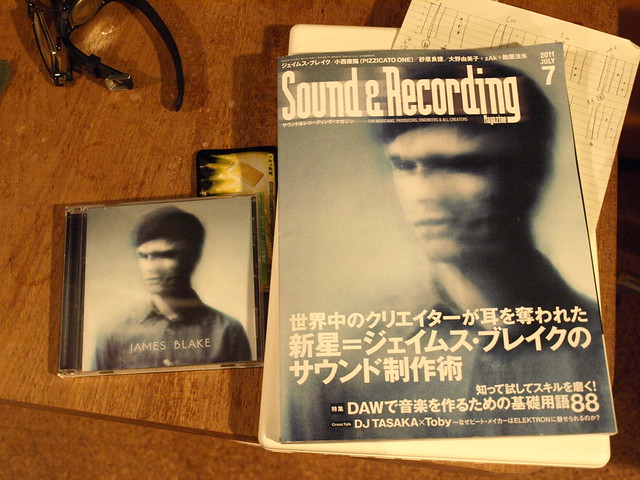
It's not entirely clear why or how this happened. He's backed here by the Universal International label, but there aren't overwhelming signs of where that power is going. He's had prominent listening station placement in Tower Shibuya, but that's not something that requires a major label's backing. He was recently featured on the cover of Sound and Recording magazine, a very prominent magazine but hardly directed at the masses of people buying records. It's hard to argue that the music itself is in tune with the "Japanese market" as a whole, since that's overrun with a pestilence of throwaway pop that seems, at least superficially, to be satisfying public demand.
This may have been one moment of a trend I would like to substantiate. What if, as the music industry as a whole declines (and it is declining in Japan, albeit more slowly than in the U.S.), artists who people are more deeply invested in decline less steeply than more disposable pop? What if owning an album like "James Blake" is more intimately tied up with identity creation than owning an AKB48 record? And of course, that's where my little hypothesis breaks down, because it's undeniable that the otaku gain a great deal of identity from their purchase (sometimes en masse) of AKB records and merchandise. The fact that it is inherently less valuable and interesting than James Blake, that these people are building their identities on sand, doesn't seem to make their activities any less persistent over time. In that context, the question shifts - we have to ask not, "What made this strange James Blake record successful?" but the rather more depressing, "What kept this excellent James Blake record from being a much, much bigger success?"
A friend just let me know about the fantastic and fascinating article "Japan in Japan: Notes on an Aspect of the Popular Music Record Industry in Japan," by Toru Mitsui (Popular Music, Vol. 3, Producers and Markets (1983), pp. 107-120). It's a detailed and well-informed description of, first, Japanese labels' practices in the late 1970s and early 1980s with regards to the import of foreign records, and second, of the popularity of the English band Japan in the early 1980s. Though of course not quite current, it's a great window into the subtle processes that can dictate how culture travels between modern societies.
What Mitsui primarily focuses on is the fact that by the 1970s, bidding wars between Japanese labels had made artists already well-known in the West progressively less profitable as higher and higher royalties and advances were promised. This led to Japanese labels more aggressively scouting unknown international talent, who still held a broad appeal for the Japanese market. Particularly interesting to me is that Japan were essentially an art-rock band, but they managed to attract a teenybopper audience in Japan because of their heavily made-up, androgynous image. This audience supported them through three early albums that didn't sell particularly well in England or America. David Sylvian, once a member of Japan, is now one of the leading avant-garde musicians in the West, a position he might not have achieved without the financial support of the Japanese market.
Cases of bands not popular in their home turf succeeding wildly in Japan are so common they've become a cliche. Mitsui cites the early success of Kiss in Japan, and the paradigm case is the band Mr. Big, who are essentially unknown in the West but still tour incessantly in Japan.
More recently, there's the case of James Blake. My general impression is that while he's become quite well known in the U.K., he's definitely a niche product in the U.S., pushed by fringe indie websites like Pitchfork and Gorilla vs. Bear. In Japan, while still not a star, his extremely bleak and fairly abstract album has reached the 70th spot on the Oricon album charts since its release about six weeks ago (I'm really wishing I had a full Oricon subscription right now). According to an interview with Ele-King, his import singles were selling out back in February, the kind of thing that builds great buzz for a domestic release. That qualifies him to represent a sort of indie/underground version of the more thoroughly dominant, but also clearly more straightforwardly marketable, likes of Kiss and Mr. Big.
 |
| Courtesy Kishimen |
It's not entirely clear why or how this happened. He's backed here by the Universal International label, but there aren't overwhelming signs of where that power is going. He's had prominent listening station placement in Tower Shibuya, but that's not something that requires a major label's backing. He was recently featured on the cover of Sound and Recording magazine, a very prominent magazine but hardly directed at the masses of people buying records. It's hard to argue that the music itself is in tune with the "Japanese market" as a whole, since that's overrun with a pestilence of throwaway pop that seems, at least superficially, to be satisfying public demand.
This may have been one moment of a trend I would like to substantiate. What if, as the music industry as a whole declines (and it is declining in Japan, albeit more slowly than in the U.S.), artists who people are more deeply invested in decline less steeply than more disposable pop? What if owning an album like "James Blake" is more intimately tied up with identity creation than owning an AKB48 record? And of course, that's where my little hypothesis breaks down, because it's undeniable that the otaku gain a great deal of identity from their purchase (sometimes en masse) of AKB records and merchandise. The fact that it is inherently less valuable and interesting than James Blake, that these people are building their identities on sand, doesn't seem to make their activities any less persistent over time. In that context, the question shifts - we have to ask not, "What made this strange James Blake record successful?" but the rather more depressing, "What kept this excellent James Blake record from being a much, much bigger success?"
Sunday, May 29, 2011
Why Isn't Chiyori Famous? or, a Grainy Endoscopy of the Japanese Music Industry
I have plenty to say here, but let's let her speak for herself first, in this video from a performance last night at a small club called Bed in Ikebukuro (Western Tokyo):
So, now you'll have at least some small sense of where I'm coming from. This is a woman with gifts in the realm of an Amy Winehouse or Adele (admittedly, this video doesn't quite do those justice), but with a fierce and unique, subtle strangeness that she seems barely aware or in control of (a fact this particular song does highlight). The question is, why is she playing a tiny club like Bed, after putting out a full-length album on a relatively high-profile indie, and putting in years worth of work building a series of events and nights (including this monthly event, Zettai-Mu, itself)? As she said herself when I walked in last night, Bed is "a pretty ghetto club," though in Tokyo that means more 'marginal and cheap' than 'sketchy and dangerous' (You can read her blog here (Japanese), and hear a few more polished recordings here).
In fact, I had a far better time there last night than I did on Friday at Air, which had a vastly superior soundsystem, some great DJs, and all the personality and atmosphere of a Soviet pharmacy. Air is one of what I would call Tokyo's "listening clubs," places including Daikanyama Unit, WWW in Shibuya, and Liquidroom. They have the most mind-bogglingly incredible sound systems (I'm willing to bet) of any club their size on the planet. And they're all beautiful. But they cater to an aggressively upscale trendy market (editors note: decidedly not a 'hipster' market, but young professionals). They most often feel like a collection of strangers, though there are exceptions (for instance, when Liquidroom hosts smaller events in its upstairs lounge).
On the other hand, there are smaller places, quite literally on the outskirts, like Heavy Sick Zero in Nakano, Bed in Ikebukuro, or Family, which is able to exist in Shibuya only because it's literally the size of my apartment. These clubs host smaller, sometimes stranger, always more amateurish shows, for crowds that tend to be more intimate. They're also usually cheaper (entrance to Bed on Saturday was 1/2 to 1/3 the charge for Air on Friday, even though Air was basically just a DJ night and Bed had three bands).
So, now you'll have at least some small sense of where I'm coming from. This is a woman with gifts in the realm of an Amy Winehouse or Adele (admittedly, this video doesn't quite do those justice), but with a fierce and unique, subtle strangeness that she seems barely aware or in control of (a fact this particular song does highlight). The question is, why is she playing a tiny club like Bed, after putting out a full-length album on a relatively high-profile indie, and putting in years worth of work building a series of events and nights (including this monthly event, Zettai-Mu, itself)? As she said herself when I walked in last night, Bed is "a pretty ghetto club," though in Tokyo that means more 'marginal and cheap' than 'sketchy and dangerous' (You can read her blog here (Japanese), and hear a few more polished recordings here).
In fact, I had a far better time there last night than I did on Friday at Air, which had a vastly superior soundsystem, some great DJs, and all the personality and atmosphere of a Soviet pharmacy. Air is one of what I would call Tokyo's "listening clubs," places including Daikanyama Unit, WWW in Shibuya, and Liquidroom. They have the most mind-bogglingly incredible sound systems (I'm willing to bet) of any club their size on the planet. And they're all beautiful. But they cater to an aggressively upscale trendy market (editors note: decidedly not a 'hipster' market, but young professionals). They most often feel like a collection of strangers, though there are exceptions (for instance, when Liquidroom hosts smaller events in its upstairs lounge).
On the other hand, there are smaller places, quite literally on the outskirts, like Heavy Sick Zero in Nakano, Bed in Ikebukuro, or Family, which is able to exist in Shibuya only because it's literally the size of my apartment. These clubs host smaller, sometimes stranger, always more amateurish shows, for crowds that tend to be more intimate. They're also usually cheaper (entrance to Bed on Saturday was 1/2 to 1/3 the charge for Air on Friday, even though Air was basically just a DJ night and Bed had three bands).
Friday, May 27, 2011
The Second Lost Generation - The Story of One Wandering Japanese Engineer
At first it might not seem that cataclysmic that only 90.1 percent of Japanese college grads had jobs lined up on graduation. But the current slump is likely to create a "lost generation" in which large numbers of probably high achievers are completely or largely locked out of the conventional job market, and forced into part-time, temporary, or international work. That's because of a hiring system that only gives seekers one shot - in the period just after they graduate. Those who either want to take some time off, or who slip through the hiring cracks despite a sincere effort, are out of luck. I spent about eight months after my (alread unconventionally late) graduation living on a friends' couch, substitute teaching, then hitchhiking across the U.S. and travelling in Mexico. If I had been Japanese, I'd have been screwed.
I had a brief conversation last night with a guy who has actually had to leave Japan twice for economic reasons. He was part of a previous 'lost generation' of the mid-1990s, and had ended up living and working in New Jersey for several years as a young man, including being in the National Guard, which he told me was a possibility for permanent residents - news to me. This is of course pretty adventurous, and he seemed like he'd banked some pretty amazing experiences, but what he wasn't doing during the most dynamic phase of his life was contributing to Japanese economy and society.
He did eventually get back to Japan and, with the experience accrued (in engineering) in America, got a job with the Japanese arm of a European company. And then came the Lehmann shock, and the Tokyo office got folded and combined with the Shanghai branch. So he was back on his ass, and subsequently couldn't find work for a year. Now he's doing some (frankly illegal) entrepreneuring, running a company that scans books from Amazon Japan for use on e-readers, since there is as yet no e-book market there. He had imported a Kindle from the U.S. (which I've seen before but this time particularly struck me as impressive) and clearly had a lot to offer in terms of insight and innovation to Japanese society. Unfortunately (as confirmed by the small anarchist bar where I ran into him) he's now been almost totally relegated to the fringes, where it's unlikely he'll have an easy path to making those contributions.
In the economic tumult following Japan's largest natural disaster, there will be more like my new friend, having to improvise to survive outside of the mainstream of Japanese business culture. The question is whether there will be any more second chances for them, or any new effort by the nation to make the most of its infamously dwindling workforce.
I had a brief conversation last night with a guy who has actually had to leave Japan twice for economic reasons. He was part of a previous 'lost generation' of the mid-1990s, and had ended up living and working in New Jersey for several years as a young man, including being in the National Guard, which he told me was a possibility for permanent residents - news to me. This is of course pretty adventurous, and he seemed like he'd banked some pretty amazing experiences, but what he wasn't doing during the most dynamic phase of his life was contributing to Japanese economy and society.
He did eventually get back to Japan and, with the experience accrued (in engineering) in America, got a job with the Japanese arm of a European company. And then came the Lehmann shock, and the Tokyo office got folded and combined with the Shanghai branch. So he was back on his ass, and subsequently couldn't find work for a year. Now he's doing some (frankly illegal) entrepreneuring, running a company that scans books from Amazon Japan for use on e-readers, since there is as yet no e-book market there. He had imported a Kindle from the U.S. (which I've seen before but this time particularly struck me as impressive) and clearly had a lot to offer in terms of insight and innovation to Japanese society. Unfortunately (as confirmed by the small anarchist bar where I ran into him) he's now been almost totally relegated to the fringes, where it's unlikely he'll have an easy path to making those contributions.
In the economic tumult following Japan's largest natural disaster, there will be more like my new friend, having to improvise to survive outside of the mainstream of Japanese business culture. The question is whether there will be any more second chances for them, or any new effort by the nation to make the most of its infamously dwindling workforce.
Tuesday, May 24, 2011
Photo Roundup: Nikko
Late last week I took a quick trip to Nikko, famous for its monkeys, hot springs, and an ornate shrine to the Tokugawa Shogunate.

The monkey thing is real. Unfortunately it seems like contact with humans has not been great for their dispositions - just moments after I took this photo, these monkeys were aggressively harassing and chasing a woman in her sixties. Hard to imagine anything more terrifying.
The monkey thing is real. Unfortunately it seems like contact with humans has not been great for their dispositions - just moments after I took this photo, these monkeys were aggressively harassing and chasing a woman in her sixties. Hard to imagine anything more terrifying.
Monday, May 23, 2011
Regarding Workers
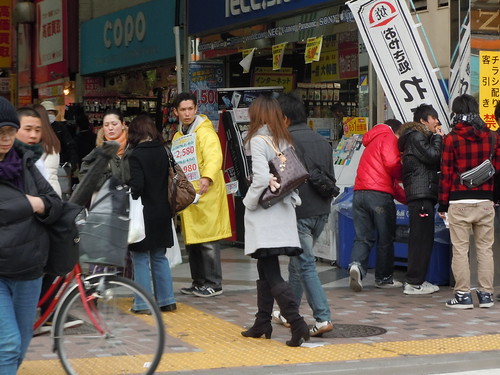
I took the above photo a couple of days after the 3.11 earthquake, mainly to illustrate the amazing speed with which Tokyo returned to everyday normality. The guy in the middle is just one subtype of an eternal Tokyo presence - the sidewalk promoter. He's giving out flyers (and probably tissue packages) to promote a contact lens shop, but you'll also see people doing much the same work in service of Italian restaurants, Karaoke boxes, manga kissaten, Korean barbecues, and hostess clubs (including the vile subspecies who harass passing young women to try and lure them into the sex industry).
I've lately been thinking about how little I understand the human element of a job like this. It's just one of a variety of undeniably crappy jobs you see people doing every day in a city like Tokyo, from fast-food server to Donki clerk to construction-site traffic-director. The last time I worked a job of this sort was about a year ago, when I did short stints as a parking-lot attendant and line-cook as part of my confused attempts to deal with unexpected funding shortfalls in my last year of grad school. Both were part-time jobs, and the line cook job was actually a hell of a lot of fun, but I ended up quitting both jobs with no notice in moments of frustration and/or overwork.
I had that option, because I knew I was on my way to other things, but I was nonetheless able to hold onto some (facile, superficial) sense of solidarity with "workers," thanks to my cushioned, provisional version of poverty, and the genuinely merciless grind of grad school, in some ways undeniably more demanding and even exploitative than this sort of service job.
Now, though, I'm realizing how much that illusion of lived solidarity was insulating me from a real consideration of the challenges posed by living in a mercilessly stratified society. Job-wise, I'm now living a ridiculous fantasy, which if not quite financially secure does happen to include total freedom. I'm suddenly not sure how to feel about the legions of workers through whom I float, to whose daily struggle I find it more and more difficult to truly relate.
Food Fetish: Nikko, Yuba, and Localism in Japanese Junk Food
Towards the end of last week I spent a couple of days in Nikko, a nice relaxing solo trip. I made a point of eating every variety of the local specialty, yuba, that I could get my hands on. Yuba is made from the curd skimmed during the process of making soy milk, and is particularly associated with Nikko because it was a source of protein for the vegetarian yamabushi (mountain monks) that populated its famous shrines (and, in smaller numbers, still do).
It's more appetizing than it sounds, making this a tasty chance to trace an archetype of Japanese food localism. In short, this localism is mostly a marketing strategy aimed at travelers that provides nominal variation while still keeping things comfortably familiar. To wit:
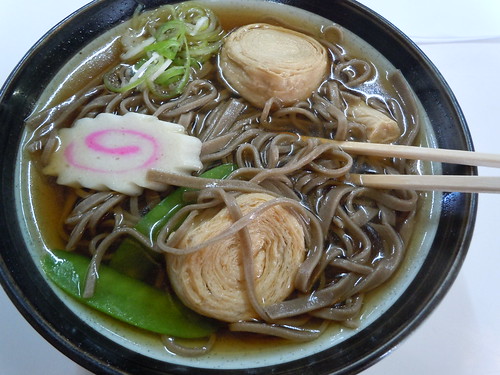
It's more appetizing than it sounds, making this a tasty chance to trace an archetype of Japanese food localism. In short, this localism is mostly a marketing strategy aimed at travelers that provides nominal variation while still keeping things comfortably familiar. To wit:
A typical bowl of soba, you say? Not at all - it's yuba soba, transformed by those yellowish rolls. This was the tastiest of the variations I tried, partly because it was eaten in a small restaurant at the end of a five-hour hike.
Sunday, May 15, 2011
FFTA
As a way of (deluding myself into thinking that I'm) practicing Japanese, I picked up a couple of Japanese-language video games. One I just started (Referenced above) begins with a forty-minute (at least) narrative sequence. According to wikipedia, the designers of this game were not drug into the streets and beaten to death upon its release. The only possible conclusion is that Wikipedia is, just as has been said for so long, an unreliable resource.
Saturday, May 14, 2011
Photo Roundup: May 2011
A few highlights from the past few weeks:
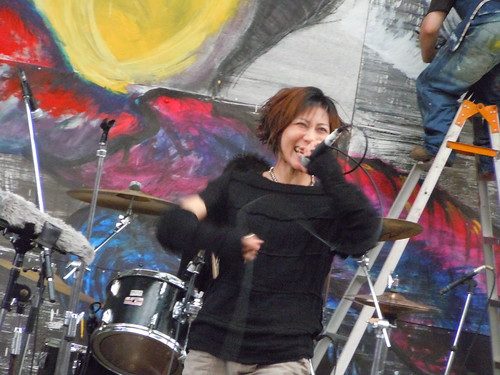
Melt Banana today, 5/14
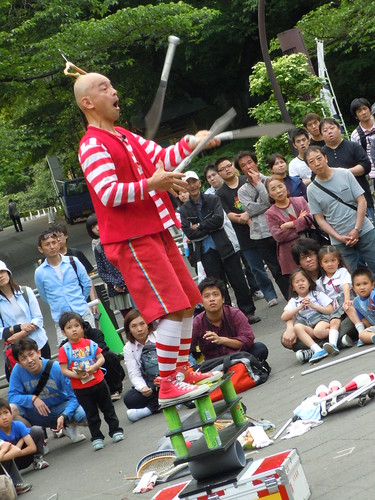
A really stunning juggler in Ueno park
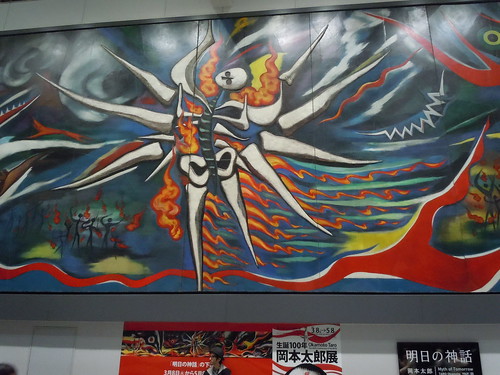
A famous mural by Okamoto Taro in Shibuya Station. Apparently the central figure is the inspiration for the apocalyptic robots of the Evangelion cartoons.
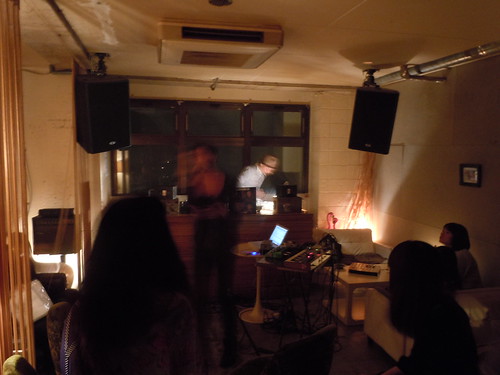
Slovenia's most popular rapper, at a small bar in Koenji called One.
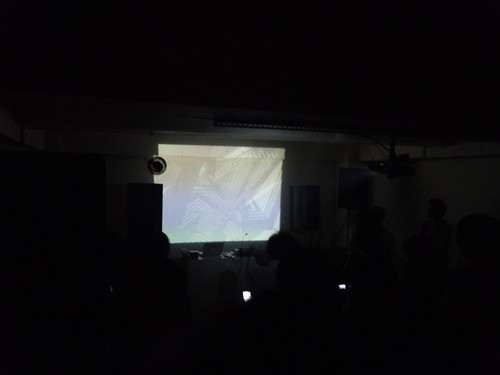
Noise and generative video at Soup, Koenji.
Melt Banana today, 5/14
A really stunning juggler in Ueno park
A famous mural by Okamoto Taro in Shibuya Station. Apparently the central figure is the inspiration for the apocalyptic robots of the Evangelion cartoons.
Slovenia's most popular rapper, at a small bar in Koenji called One.
Noise and generative video at Soup, Koenji.
Sunday, May 8, 2011
5.7 Anti-Nuclear Demo: A Simplistic Message Fuels a Profound Event
I've already waited too long to set down some version of my very intense experience at Saturday's anti-nuclear rally. The numbers coming back from news organizations paint it as a bit of a disappointment - partly due to rain, partly due to a major victory handed to activists by PM Kan just the day before, in the form of the ordered shutdown of a reactor in central Japan. Speaking strictly for myself, I think the core message of the demo - "No Nukes!" - is almost childishly simple, perhaps distracting from the really constructive project of promoting renewable energy, not to mention the more profound and radical possibilities for overhauling industrial capitalism (perish the thought).
All that aside, this was a transformative event. I came to it as someone who has attended a lot of marches put on by the central organizers of this demo, Shirouto no Ran. They frequently have demo/parties on May Day and generally are interested in poverty issues - but always with a slightly confrontational edge, including a profusion of absurdism and rnoisy music, which helped these marches palpably alienate passersby. This one was different.
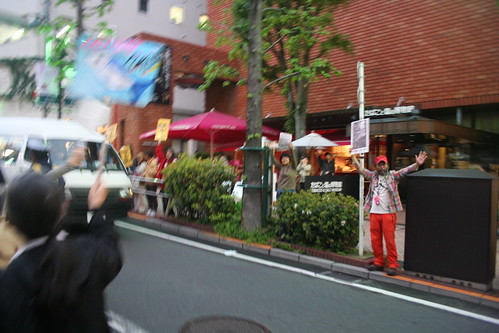
All along the route, there were both people who seem to have broken off from the march (as seen here), and those who just happened to be passing by, saw what was happening, and smiled, waved, or in some cases started cheering along. The energy was amazing.
Another great thing was how wide a spectrum of people was represented, from kids to older folks, and not just fringe or freaky people. Many of these people had never participated in this sort of demonstration before.
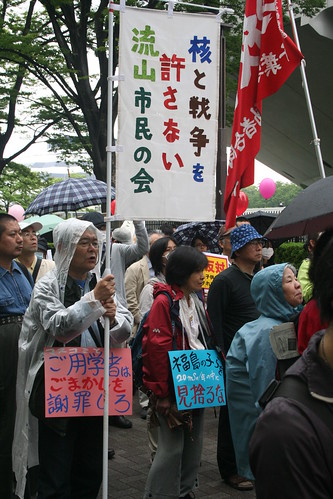
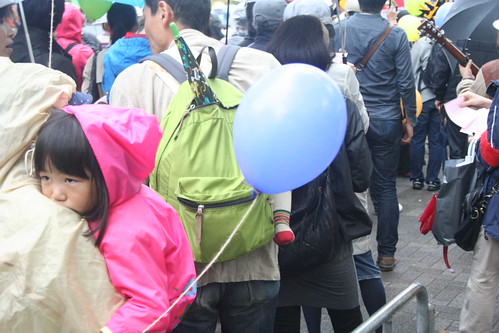
This is a huge contrast with the regular Shirouto no Ran demo, which is made up largely of punk rockers, dadaists, and other weirdos (not that there weren't some of those here).
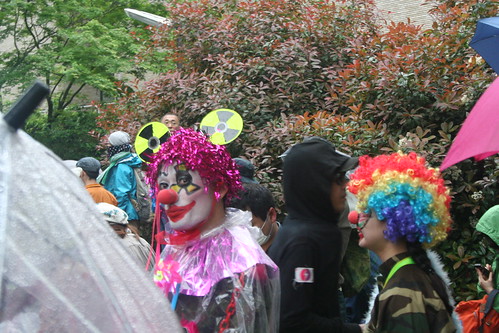
I suddenly found myself with a new appreciation for all those slightly alienated May Day marches, whose effectiveness I've always been pretty skeptical of. They were dress rehearsals for this - an issue powerful enough to draw in people, who just need experienced organizers to give them an outlet for their anxiety and anger.
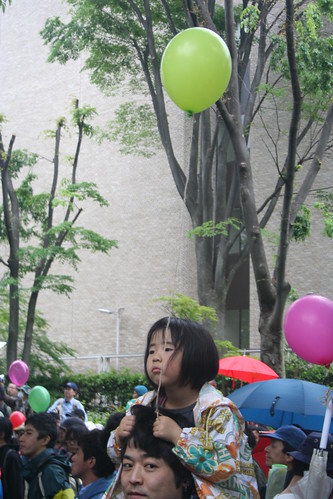
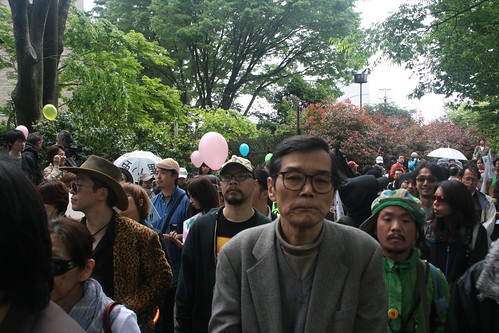
All that aside, this was a transformative event. I came to it as someone who has attended a lot of marches put on by the central organizers of this demo, Shirouto no Ran. They frequently have demo/parties on May Day and generally are interested in poverty issues - but always with a slightly confrontational edge, including a profusion of absurdism and rnoisy music, which helped these marches palpably alienate passersby. This one was different.
All along the route, there were both people who seem to have broken off from the march (as seen here), and those who just happened to be passing by, saw what was happening, and smiled, waved, or in some cases started cheering along. The energy was amazing.
Another great thing was how wide a spectrum of people was represented, from kids to older folks, and not just fringe or freaky people. Many of these people had never participated in this sort of demonstration before.
This is a huge contrast with the regular Shirouto no Ran demo, which is made up largely of punk rockers, dadaists, and other weirdos (not that there weren't some of those here).
I suddenly found myself with a new appreciation for all those slightly alienated May Day marches, whose effectiveness I've always been pretty skeptical of. They were dress rehearsals for this - an issue powerful enough to draw in people, who just need experienced organizers to give them an outlet for their anxiety and anger.
Tiny Steps
A common sight on the streets of Tokyo is a man, perhaps in his late seventies, shuffling along the sidewalk, taking steps of no more than three or four centimeters at a time, carefully supporting himself first by a bit of wall, then a pole, then a guardrail. They move with an almost unreal slowness as everyone else on the sidewalk streams around them.
Another common sight is women, also in their late seventies or early eighties, bent nearly double by osteoporosis and hanging onto a walker or grocery cart as if to a chariot speeding out of control as they slowly totter down the street.
These are people old enough to have suffered two abuses. Their health can't have been helped by childhoods lived during the postwar years of near-starvation. And their society has changed beneath their feet from one in which social standards still provided some protection for the elderly (if not the more elusive respect that Orientalism imagines) to one seeking to replace familial trust with indequate state support.
Another common sight is women, also in their late seventies or early eighties, bent nearly double by osteoporosis and hanging onto a walker or grocery cart as if to a chariot speeding out of control as they slowly totter down the street.
These are people old enough to have suffered two abuses. Their health can't have been helped by childhoods lived during the postwar years of near-starvation. And their society has changed beneath their feet from one in which social standards still provided some protection for the elderly (if not the more elusive respect that Orientalism imagines) to one seeking to replace familial trust with indequate state support.
Sunday, April 17, 2011
The Situation: Ishinomaki and Touhoku Relief
I've just gotten back from a week doing cleanup and recovery work in Ishinomaki, a mid-size coastal city in the Touhoku area, north of Sendai. It will take some time to process the experience, so the following notes will be fragmentary, but the most obvious thing I learned is very simple - while financial contributions are vital, what Ishinomaki and cities like it are most badly in need of is boots on the ground. After the tsunami deposited thousands of tons of (probably toxic) mud throughout even the buildings it left standing, the amount of labor required to get even the relatively undamaged part of the city back to a state of usability is mind-boggling - and this is just one city out of dozens or hundreds so affected. Peace Boat is currently the only NPO accepting international volunteers in the affected areas, so if you can spare a week and have a tolerance for camping and hard labor, please contact them.

The Peace Boat deployment center is currently located on the campus of Ishinomaki Senshuu Daigaku (Ishinomaki Professional University). Conditions were cold early in the week, but they're warming up day by day and were fairly comfortable by the time we left.

This is what the upper part of Ishinomaki looks like three weeks after the Tsunami. The roads are cleared, but there is still debris everywhere. The wave entered every building, destroying furniture and fixtures and saturating every first-floor shop and residence with mud.
Tuesday, April 5, 2011
Hard In the Paint: Interview with Live Paint Team Doppel
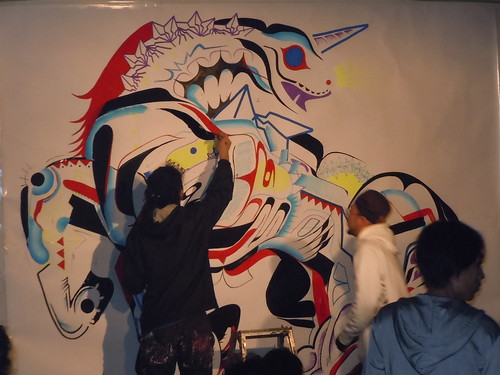
One really distinct thing about Japanese hip hop shows and parties is the frequent inclusion of a live paint, which is just what it sounds like - painters producing art live. Most often, the painting takes place over the course of three to five hours, slowly progressing, and giving things a real three-ring-circus feel, especially in certain of Tokyo's big clubs.
Doppel is a two-man team, Baki Baki and Mon, who have been doing live paint events together (as well as separately) since 2001. I saw them in March at Superdeluxe, where they did an unusual and compelling timed paint – they gave themselves exactly 20 minutes between acts to complete what turned into an elaborate, Ainu/Inuit inspired painting of a rearing horse-like creature. The timed element made it even more entertaining than the live paints usually are. The questions here were answered by member Mon (Koutaro Oyama) on behalf of the group.
Q: Were you originally inspired to do art by graffiti or hip hop?
A: The motive to start painting was separate from hip hop. Basically, we were both mostly inspired by Japanese manga and anime. But after starting, hip hop has had a huge influence on us. At the beginning, more than American graffiti, we were really influenced by KAMI and DELTA, graffiti artists from about two generations before us.
Q: Is Live Painting mostly done at hip hop shows?
A: We do it at shows in all kinds of genres. The first thing we did was a Drum and Bass party. Of course, we do a lot of hip hop shows, but also a lot of techno, house, and other kinds of dance parties.
Q: Have you ever done street graffiti?
A: Yeah, we do all kinds of tagging and stickering.
Q: Have you done other ‘timed’ events like the one at Superdeluxe?
A: Yeah, we did a 20 minute set at a party called HUOVA. As far as we know, that’s the first party to use that sort of time limit.
Q: I’ve seen similar Live Paint events happening in Cali. But it started in Japan, right?
A: We’re not sure whether or not it started in Japan. Graffiti artists have probably been writing at parties for a long time.
But our genre isn’t graffiti per se, it’s live painting [specifically]. After we started doing live paints, we met this guy named Heavyweight from Canada, and we were really influenced by his style. As far as Japan, Live Painting is a scene that started from the clubs and spread out. That’s why we use brushes and paint instead of spraypaint (spraying in a club can get rough). Now there are live paint artists all over Japan. We got started very early in that history. As far as artists doing live painting specifically, we were really among the first.
Q: Before a show, do you practice? For example, in circumstances similar to the show?
A: Almost never. Even when we practice, it’s not really connected to a [specific] show.
Q: At Superdeluxe, you painted together. Did you have a plan?
A: To a certain degree, we had a course of action. That was for the series called “Chimera.” At the Superdeluxe show, we’d only chosen that the lower half of the body would be a horse.
Q: At that show, the picture eventually became a horse [My mistake – a horse-like chimera]. It was suspenseful, though. Do you do things that way for the enjoyment of the audience?
A: Exactly. Depending on the order you lay down the details, a live paint can be dramatic, or it can be boring. Our ideal is that watching our shows will be just as exciting as watching sports.
Q: Is acting or performance important to the Paint?
A: It’s not important. We’re never acting. Sometimes we’ll shout or throw our hands up to get the crowd going, but it’s really not important.
Q: After the event, what happens to the paintings?
A: We keep them, and put a protective coating on them or frame them so they can be put on display.
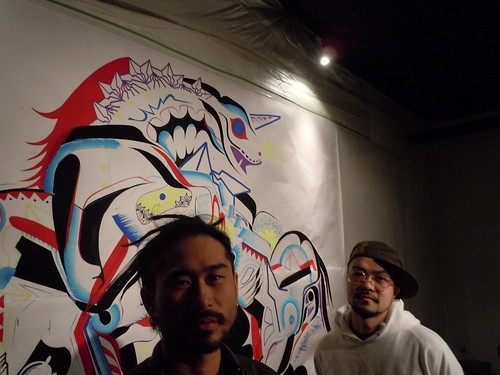
Information about Doppel can be found at:
Sunday, March 13, 2011
Tokyo Waits for the Other Shoe
Things are extremely odd in Tokyo right now. On the one hand, many people have returned to work, trains are largely running again, the projected blackout was postponed, and the streets are completely calm. On the other hand, retail stores are full of people stocking up on water, batteries, flashlights, and candles. Shelves in convenience stores and places like Don Quixote (sort of like Wal-mart) are emptying of perishables such as bread. Even smaller stores are getting raided (and by raided, I mean "politely queued up to"). My local butcher is quickly running low. I got the last pack of tea candles at Tokyu Grocery, which is rationing all drinks to 3 PET bottles per customer. It seems most people are still unsure what the ripple effects of the quake are going to be.
Subscribe to:
Posts (Atom)