After a conversation I've now forgotten, with a person I can no longer remember, I still managed to write down three amazing tips on books I need to follow up on for my work-in-progress on car audio and territorialization.
Julian Henriques, Sonic Bodies
Steve Goodman, Sonic Warfare
Peter Doyle, Echo and Reverb
Showing posts with label ethnography. Show all posts
Showing posts with label ethnography. Show all posts
Friday, March 15, 2013

Friday, May 11, 2012
Anarchism and Japan's Anti-Nuclear Movement: Part 2
Here's part 2 of my
recent talk at All Power to the Imagination, about Tokyo's anarchists and the antinuclear movement. Enjoy!
Wednesday, June 1, 2011
New Glaciers of Ice: "Low (inst)"
Low (inst) by Glaciers of Ice
What may superficially look like a fun side project or even a "hobby" insidiously links back to my professional life. Making music isn't just important in its own right, but is also a way to better understand the musicians that I write about. But as I get better at it myself, these rationalizations and diversions become less and less important.
What may superficially look like a fun side project or even a "hobby" insidiously links back to my professional life. Making music isn't just important in its own right, but is also a way to better understand the musicians that I write about. But as I get better at it myself, these rationalizations and diversions become less and less important.
Monday, May 23, 2011
Regarding Workers
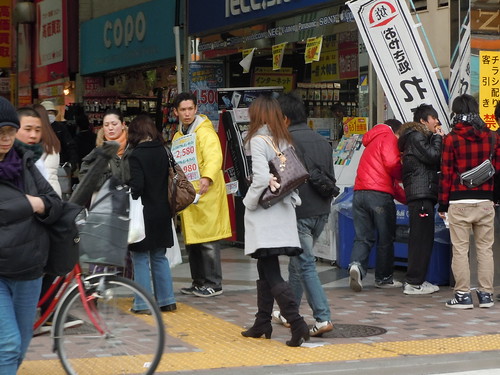
I took the above photo a couple of days after the 3.11 earthquake, mainly to illustrate the amazing speed with which Tokyo returned to everyday normality. The guy in the middle is just one subtype of an eternal Tokyo presence - the sidewalk promoter. He's giving out flyers (and probably tissue packages) to promote a contact lens shop, but you'll also see people doing much the same work in service of Italian restaurants, Karaoke boxes, manga kissaten, Korean barbecues, and hostess clubs (including the vile subspecies who harass passing young women to try and lure them into the sex industry).
I've lately been thinking about how little I understand the human element of a job like this. It's just one of a variety of undeniably crappy jobs you see people doing every day in a city like Tokyo, from fast-food server to Donki clerk to construction-site traffic-director. The last time I worked a job of this sort was about a year ago, when I did short stints as a parking-lot attendant and line-cook as part of my confused attempts to deal with unexpected funding shortfalls in my last year of grad school. Both were part-time jobs, and the line cook job was actually a hell of a lot of fun, but I ended up quitting both jobs with no notice in moments of frustration and/or overwork.
I had that option, because I knew I was on my way to other things, but I was nonetheless able to hold onto some (facile, superficial) sense of solidarity with "workers," thanks to my cushioned, provisional version of poverty, and the genuinely merciless grind of grad school, in some ways undeniably more demanding and even exploitative than this sort of service job.
Now, though, I'm realizing how much that illusion of lived solidarity was insulating me from a real consideration of the challenges posed by living in a mercilessly stratified society. Job-wise, I'm now living a ridiculous fantasy, which if not quite financially secure does happen to include total freedom. I'm suddenly not sure how to feel about the legions of workers through whom I float, to whose daily struggle I find it more and more difficult to truly relate.
Tuesday, February 8, 2011
A Job You're Supposed to be Terrible At: Lessons from Six Months of Fieldwork
As of this morning, I've officially been in Japan for six months, at the pleasure of the Japanese Society for the Promotion of Science. I have six months left on my current appointment, which was granted to me to fund research into Japanese hip hop. Ethnography/fieldwork/journalism/ “research” is something you can only learn by doing it, and despite some previous experience this stretch has been full of new challenges. I guess it's a pretty rare situation I find myself in, but maybe more universal principles can be derived from the various ways I've screwed up.

Writing is an Excuse for Not Working. In the afterglow of completing a dissertation that was at best 15% fieldwork, this has been the biggest, hardest lesson. I had worked hard to develop a craftsman's discipline – getting up every day and writing for three or four hours, crawling bit by bit through a big project. Writing was the be all and end all, the Alpha and Omega of my existence as a doctoral candidate, and as a job seeker in the academic market. So it was strange when, on finding out about my posting, a member of my committee gave me this sterling advice: “Don't worry about writing. Focus on research.”
Research is What Happens While you Make Plans. It's important – even vital – to have a research agenda. There are, of course, plans to be made, appointments to set up, contacts to cultivate online. But it's even more vital to figure out the right place to spend time doing nothing. This may seem like the most obvious thing in the world to properly trained ethnographers or anthropologists, but particularly for someone trained in theory, it takes a while to sink in. I end up with notebook pages full of hot leads, new contacts, and essential facts just from sitting in a bar or in someone's office with no particular agenda. It's a lesson for life, really – be ready for anything, including boredom. Boredom, after all, is the seedbed of opportunity.
Booze is in Fact Not an an Ethnographer’s Best Friend. I (and I know I’m not alone in this) drank a lot in graduate school. Considerably more, even, than I drank in college. Since most of my initial research took place in bars and nightclubs, the habit naturally continued during my doctoral research. And on some level I found it a lot easier to interact with people in Japanese after downing a few beers. But there comes a certain inflection point where that method of connecting to people becomes less and less effective – particularly, this is true once you’re already a known quantity in a community and the job becomes much more about following up on leads and interviewing people, or more generally about pursuing a particular agenda rather than just learning “the lay of the land.” I actually had to quit drinking entirely for health reasons about a month ago (don’t mix booze and allergy meds!), and I’ve found myself a lot more effective since then, because I’m able to be more methodical and less impressionistic. Not to mention the crazy amounts of money I’ve saved.
Quit Getting Up So Early. Depending on your specialty, a corollary to Lesson 2. In the world of music, the only things that are going to happen before noon are things you do alone. And that's not where the action is.
Shit Happens (So Take Care of Yourself). On top of the predictable challenges and time-consumption of moving and settling into a foreign country, I got pretty ill for about two and a half months this past fall. This wasn't a life-threatening illness, but rather a combination of allergies and sinus infections that took my energy levels and focus down to about 70%. I spent this period repeatedly cursing myself for collapsing exhausted before getting out to shows where I could do research (see also Lesson 3), meanwhile feeling certain that health was just around the corner. What I didn't do was go to the frickin' doctor. The language barrier was certainly an intimidation factor, but I should have known better.
And finally, Blogging is Fantastic. Not only does an online notebook give you a great place to collect the random thoughts and tidbits of information that collect like whitecap flotsam during a project like this, without drawing you into the vortextual depths of overthinking, it simultaneously gives you a platform for networking, an increasingly vital element of research - to say nothing of the infinite joys of self-promotion.
And finally, Blogging is Fantastic. Not only does an online notebook give you a great place to collect the random thoughts and tidbits of information that collect like whitecap flotsam during a project like this, without drawing you into the vortextual depths of overthinking, it simultaneously gives you a platform for networking, an increasingly vital element of research - to say nothing of the infinite joys of self-promotion.
Friday, January 14, 2011
Minds in Bodies and Bodies in Mind
I've spent the last three or four years in a strange sort of denial. I can't remember exactly when it started, because it was an experience I didn't have much frame of reference for, but every fall recently has brought a set of subtle but insidious symptoms, worst of which was a fatigue that cut my energy levels to about 70% - enough to slow me down severely, but not, it turned out, enough to stop me in my tracks long enough to seriously reflect on what was going on. What I ended up doing was confusing my physical state for a mental condition - I thought, during these stretches, that I was 'coming down with' depression, after years of being pretty much an Energizer Bunny of positivity and accomplishment. Last year in particular, the fall involved juggling two or three different jobs while trying to finish my dissertation and searching for a job, and fatigue and anxiety seemed only natural.

This fall was a different story, but also the same story. As some of you know I'm currently a research fellow, which leaves me with a lot of time - but this fall I found it desperately difficult to make use of it, even after my initial settling-in period here in Tokyo had passed. I was unfocused, and didn't set about getting interviews and other ethnographic work together with my usual single-mindedness. I started, again, feeling bad about myself as a person, berating myself for running out of energy before my usual late-night fieldwork got underway. At the same time, I was aware that at least part of the problem was that I was physically not at my best. The one thing I had been able to be objective about the previous falls was a series of sinus infections and colds, and again, this time around, I took some cold pills and antihistamines, but they didn't really do the trick. I basically soldiered on, and fell further and further out of touch with a sense of myself as capable of accomplishing anything with the huge gift of time I'd been given.
Then, two weeks ago, I learned the hard way that antihistamines and pseudoephedrine didn't mix well with even moderate drinking.
Subscribe to:
Posts (Atom)