Showing posts with label art. Show all posts

Thursday, August 2, 2012

Saint Petersburg Museum of Fine Arts: George Inness, Mary L. Proctor, Victor DuBreuil

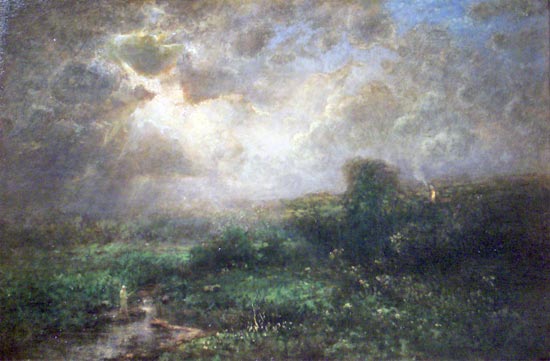
I finally got out to the small museum here in St. Pete.  It's the kind of museum where they have everything from pop art to Jain shrines.  These sorts of places are hard to really enjoy as total experiences, but I did get exposed to a few interesting new artists.  George Inness, the landscape artist (seen above), has a kind of mystical haziness that I really appreciate.


The museum also has a piece by Mary L. Proctor, a folk artist.  The piece in the museum is really spectacular and wild, though unfortunately it seems that more recently Proctor, who is now something of an institutionalized folk art figure, has turned to slightly more kitsch work like that above.


Finally, there's Victor Dubreuil a late-18th century "painter of money," represented by the work above.  I've been doing a lot of writing and research about money as a medium lately, so it's doubly interesting to learn that there was an entire movement of money painters who produced representations of representations of value.


Sunday, July 29, 2012

Norman Towle: St. Petersburg's Henry Darger?

Note: I now blog at Blownhorizonz.com.  It's much prettier to look at, and more focused on fun stuff like weird fiction, extreme music, and awesome art (like this!).  Also check out my Tumblr at blownhorizonz.tumblr.com.

Last night I hit the opening of one of the more exciting and challenging gallery shows I've seen in a while. The show is at the Venture Compound, a D.I.Y. music and art space in St. Petersburg, FL, and the opening coincided with the 29th installation of the Pangaea Project, an ambitious noise/avante-garde series curated by the Venture group.  The art is by Norman Towle, who died recently at the age of 99.  The show is said to encompass 95% of the work Towle produced in his lifetime.

Knowing Towle's story is key to understanding why this apparently unassuming work is so interesting.  After spending time in the Merchant Marine, Towle attended a technical art institute, then spent several decades as a commercial art retoucher, largely working for the New York Times.  He retired to Florida, only after which, apparently, he actually began to produce art of his own.

And what art.  The works - over a hundred of them - cover everything from local St. Petersburg landscapes, portraits of public figures, nonspecific scenes of everything from dancing to ocean life, abstract works that include elements of collage, and a little bit of softcore pornography.  These are all rendered in a hand that can be described as inexpert, even clumsy.

But the whole body of work, and many of its individual pieces, are profoundly absorbing and multidimensional.  This interest isn't because the work is 'good' in any conventional sense, either technically or because it advances some coherent, self-conscious aesthetic or social message.  Towle falls in that troubled and weird category known with measured condescension as 'folk art' - works and artists whose interest derives from the unselfconsciousness of their process, which allows them to represent, at best, a set of truths as deep as those in more conventional 'high' art.


In Towle's work, as in those of so much folk art, those truths are dual-edged.  On the one hand, when we connect Towle's story to his work, we see the way that modern society can limit human possibility.  These paintings show a man with a profoundly foreshortened vision of life, someone attracted primarily to the most banal of public figures and the safest modes of existence.  There are numerous pictures here of 'beautiful' farmhouses, churches, golf courses, suburban homes, and parking lots (!), and dozens of portraits of presidents and film stars and singers and models. Towle, at least according to his paintings, saw the world exactly as NBC, the Chamber of Commerce, and the Joint Chiefs of Staff would have wanted him to.

At the same time, the traces of his own life in Towle's paintings show, through no intent of the artist, what utter lies he was reproducing.  Just as his life fulfilling the commands of others seems to have left him with little ability to reflect critically on the culture around him, decades of touching up other people's images as part of a process that reduced art to nothing but another industrial, assembly-line product seems to have left Towle himself with an imperfect command of fundamental artistic principles of perspective, figure, and color.  His apparent naive reverence for Pope John Paul and suburban normality, filtered through the imperfections that this banal world imposed on his abilities, reveals the absurdity, beauty, and even brutality of modern 'everyday life.'

There's also something profoundly troubling about a man trained in 'art' who produced no work of his own until retiring from his career in the art world.  There's a particular piece here that captures that poignancy - a desolately kitsch landscape of a flower garden, which nonetheless stands out from the other paintings in its technical refinement.  This is apparently another artist's work that Towle gave a few small touch-ups . . . and then signed.  It's one of those instances where the unvarnished reality of folk art manages to convey the desperation and sadness of the human condition far more effectively than 'high' art.  Here and elsewhere, Towle's work, in its way, shows the darkness that lies beneath the facade of normality better than Francis Bacon's.
 

But Towle's work also shows the ability of people to transcend the limits imposed on them by society.  Every observation of Towle's technical limitations comes with the caveat that a great deal of this work was completed when he was in his 80s and 90s, with a hand that would have been unsteady for reasons having nothing to do with skill.  That he persevered at that age at producing any art at all is some kind of testament to human creative energy.  And there's a real joy to lot of the paintings,  something that could be seen as either childlike or just sincere.  It's particularly worth remembering that, as someone born in the early 1920s, who served in the military during the 1940s, Towle would have been close to enough darkness in his life that he might not have had much interest in reproducing it.  What looks to people my age like suburban banality and empty-headed celebrity culture may have been a fully justified retreat to psychic safety for those brutalized by world history and the machinations of social elites.


Saturday, January 8, 2011

"Transformation" at Tokyo Museum of Contemporary Art: Bio-Viewing

I spent about four hours yesterday cruising through the TMOCA exhibit "Transformations," which is ending a the end of this month. It's absolutely essential for anyone with an interest in art, and likely important for anyone who thinks seriously about the show's particular themes - the status of humans in an era of advancing biotechnology. The exhibit deals with things like genetic engineering and artificial limbs, but also more abstract ideas of transformation. It's so full of amazing stuff I didn't have time to fully absorb all of it, much less the energy to keep going to the current display from the permanent collection, so I plan to go again soon.

It's an amazing museum and this exhibit is not to be missed - but there are definitely some problems. The biggest head-scratcher was that Matthew Barney's Cremaster 3 is being shown in its entirety on two small LCD screens suspended above an installation, in a gallery room full of film stills. Since the film is still impossible to legally see outside of a museum, this leaves the option of standing for an hour and a half, or sitting against a wall. On top of that, since it's showing in a fully lit gallery instead of a screening room, parts of the occasionally very dark film are just hard to see. Especially since so much space was given to other films, this seems crazy. I can only think of two explanations - either there was an assumption that people have already seen Cremaster 3 and only needed a refresher, or Barney didn't agree to a full-scale screening as part of his broader tendency to limit access to the work.

Masakatsu Takagi
More generally, though, there were just too many films, which led both to viewing fatigue and, worst of all, some sound bleed - particularly in one section where Sputniko!'s techno-pumping installation threatened to break the suspension of disbelief fostered by Masakatsu Takagi's enthralling Ymene.  That work still managed to be the show's greatest discovery for me - conceived as a "bird's-eye-view" video, it uses video manipulation techniques that are completely impossible to describe, and has the visceral impact of a roller coaster ride.  It's mind-bending in the best possible way, and absolutely worth experiencing even in somewhat compromised conditions.

Other highlights included Jan Fabre's amazing self-portrait busts, in which he molds horns of real-life species onto his own head, Lee Bul's somehow acutely Asian robots, and Patricia Piccini's deeply uncanny short about a mermaid.  I'm late enough getting to this show I can't justify a full writeup, but suffice it to say, if you live in Tokyo or will be here in the next few weeks, you owe it to yourself to go.

Thursday, December 16, 2010

Life is Decay: Tinymixtapes' Top 25 Album Covers of the Year

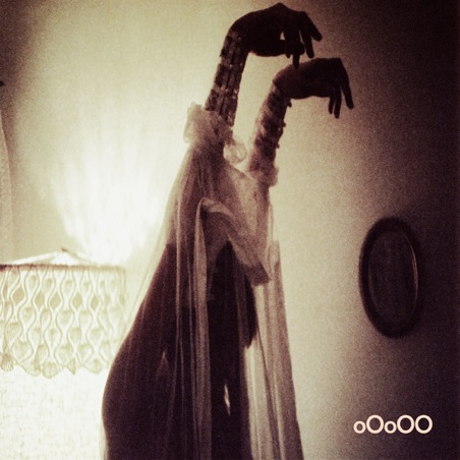
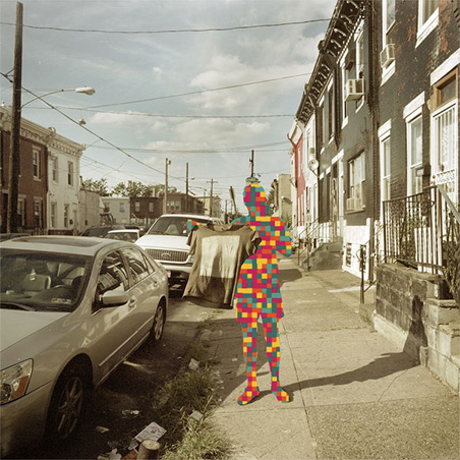
A couple of days ago, the main website I write for put out their list of the best 25 album covers of the year. It's a bit of a methadone situation, because I'm anxiously waiting for TMT's best records of the year list (which I voted on and wrote a blurb for) to come out.  But the covers list is interesting in its own right, mainly because this year I really got back into music, and I feel really invested in both a lot of particular records and the general gestalt.  The covers list (which I wasn't involved in) forms an amazingly coherent statement about our life and times, even independent of the records in question, many of which I haven't heard.
oOoOO - oOoOO

The main theme that I was struck by was simply that of imperfection and limitation adding up to something very intentional and careful.  TMT is arguably the biggest site that really has a substantial focus on experimental and "noise" acts (a label that is quickly becoming, like "indie" and "alternative" before it, more about approach and attitude than sound), and the world that today's noise bands live in is one that is decaying.  There's not a more accurate way to try and reflect back the condition of the first world these days, which can basically be divided into those fighting decline (Europe) moping about it (Japan) and living in spirited idiot denial (America).  Either way, this mechanical bull is falling apart.

Teams - We Have a Room With Everything
But it's great to enter the worlds of (visual and musical) artists who neither deny that reality nor accede to it.  2010's best record covers show what's possible with primitive tools, with recycled images, with old aesthetics.  Things get weird, and wonderful, and point toward the possibilities of how to live a more enchanted life even if you have less to live it with.  It's something I struggle with - I just started making real money, and I know that I've foreclosed some portion of joy to get here.  It's a roundabout route to get back to it.

Small Black/Washed Out "You'll See It"/"Despicable Dogs" 7-inch
One way to try and reconnect with the possibility of being happy is to constantly search for the wonderful and strange in the everyday - or even to make it yourself.  I don't think anyone has ever really taken graffiti seriously enough, or done enough street theater, or spent enough time ranting like a madman on a street corner.  We all deserve to live weirder lives.  Some of us have gotten way too comfortable with the idea of 'going out' as this one very regimented way of having a good time.  I think about all this stuff because I've known people who live differently - have collage night!  and sewing circles! and just hang out and jam! and yet somehow I've never quite been that person.  I like to watch TV and play video games, and mostly to read and write.  Sometimes other people scare me.  But there's this amazing world in my head and it's great to see some suggestion that in fact it's in other people too.

Sometimes it's impossible to put our feelings into words - feelings of otherworldliness, of expansiveness, of infinite possibility.  Music is maybe the best way to get those thoughts out into the world, and give them form. But clearly, there are ways to do it visually, too.
Gatekeeper - Giza

Wednesday, October 13, 2010

Japanese Horror-Ween 2: Fuyuko Matsui

Note: I'm now blogging at Blownhorizonz.com.  It's more attractive, and it focuses more on cool stuff like noisey music, weird art, and fiction.  Check it out!

Fuyuko Matsui (or, in Japanese, Matsui Fuyuko) is a young and fast-rising Japanese artist who produces images that are both explicitly gruesome in a very modern way, and moody, dark, and subtle in the tradition of a certain kind of Japanese ghost story. She is known almost as much for being beautiful and putting a lot of work into self-presentation as she is as an artist - she shows up on the cover of magazines much as would actresses in the U.S.  Naturally, her fame is based on drawings of ghost dogs ripping the living flesh from screaming women:


To see even more, including undead snakes, for chrissakes, try her official site as well as this strangely meticulous livejournal entry (do people still use that?).

I'm really of two minds on Matsui.  As a genre fan, her work is mind-blowing - it's smart, meticulous, titillating, and disgusting.  It takes you to another world just as effectively as the work of people like Rom Villaseran or Brecht Vandenbrouke (see, you learned about THREE artists today!).  But I think that ultimately it's genre work, not Art with a capital DEEP, and the idea that she's some kind of celebrity is a little disquieting.  I don't gather that she's really of the Andy Warhol/Lady Gaga school, where her fame is somehow meta-commentary, and it seems unlikely that such gruesome work would form the foundation for fame if she wasn't also a pretty lady. But nonetheless - this is some great work for those of us with morbid minds.