Enjoy the lush view of my backside as I talk about media structure and how opposition media workers can use it for their own ends. Things get interesting towards the end when Vermin Supreme drops by!
Showing posts with label institutions. Show all posts
Showing posts with label institutions. Show all posts
Tuesday, September 4, 2012

Wednesday, June 27, 2012
Actually Awesome Anarchism: Valve Software
Note: I now blog at Blownhorizonz.com. It's much prettier to look at, and more focused on fun stuff like weird fiction, extreme music, and awesome art. Also check out my Tumblr at blownhorizonz.tumblr.com.

Another sterling example has just come to my attention - Valve Software, probably the single most creative large video game studio in the world, is run on nonhierarchical syndicalist lines. Projects are not assigned, but are created and spearheaded from the bottom up by self-constituted teams subject to flux. There are even serious elements of communalism, as pay rates are at least in part based on a system of mutual value ratings. You can read more about these practices at The Wall Street Journal and Develop Online.
The example does highlight a consistently emerging caveat - obviously, a software development company is generally staffed by people who are already highly trained, motivated, and disciplined. And even within the company's own literature, there's an acknowledgment that when someone who doesn't fit that mold lands a job at the company, it can be disruptive and take some time to shake out. Does this indicate that anarchism, for all its bottom-up rhetoric, works best at its highest level of institutional development when it's being used to organize the elite? Regardless, it's yet another exciting sign that we're looking at the political philosophy of the 21st century. Not only is it right - it works.
Sunday, March 13, 2011
The 2011 Great Touhoku Earthquake: Civilization and Enlightenment Triumphant?
UPDATE: As the New Yorker has pointed out, early casualty estimates have turned out to be vastly short of reality. This piece was written back when we still thought we'd dodged a bullet, and I'm going to let it stand as evidence of that moment. More commentary on the process of unfolding knowledge, however, will be forthcoming.
Three days ago I lived through what has now been confirmed as one of the largest earthquakes in recorded history. Luckily, I was a small but crucial distance from the epicenter, in Tokyo, but the ground here still rolled and tumbled in a way that even Japanese people had never felt before. For the two or three minutes of the quake, I stood in the doorframe opening onto my porch, watching the tangle of power lines passing along the street sway crazily. It seemed not just possible, but probable that one or more of the complicated systems that sustain this mass hive of human life would come crashing down, its shards spreading death and destruction.
Three days ago I lived through what has now been confirmed as one of the largest earthquakes in recorded history. Luckily, I was a small but crucial distance from the epicenter, in Tokyo, but the ground here still rolled and tumbled in a way that even Japanese people had never felt before. For the two or three minutes of the quake, I stood in the doorframe opening onto my porch, watching the tangle of power lines passing along the street sway crazily. It seemed not just possible, but probable that one or more of the complicated systems that sustain this mass hive of human life would come crashing down, its shards spreading death and destruction.
 |
| Tokyo 1923 |
That didn’t happen – Tokyo stands now almost as if the quake never happened. Just a few crumbled facades, quickly covered with neat tarps and scaffolding, remain to indicate what happened. For the moment, we’ve been lucky – by the time it got to Tokyo, the quake was only about a 6.0 magnitude. But there’s no guarantee that a quake of equal or greater magnitude won’t hit Tokyo more directly, within the next couple of days. This means we could all be in a new, unpredictable situation with little or no warning.
But what exactly is that situation? The last major Tokyo quake, the Great Kanto Earthquake in 1923, struck a much different society. Compare that quake, a magnitude 7.5 which killed between 100,000 and 140,000 people out of a regional population of 7 million, and the 1995 Kobe quake, a 6.8 in which 6,000 people died out of a total population of something like 1.5 million (That’s the 2006 census number, as I couldn’t quickly find data from the mid-1990s). The earlier quake killed something like 2% of Tokyo’s population. The latter, less than 1/10th of 1% of Kobe’s.
There are too many variables to make the comparison airtight, but it’s obvious that many things changed in the intervening years. The New York Times did a good job of summing these up – they include training and preparedness, but most important of all is a dedication to buildings that can withstand major quakes. For anyone who felt Friday’s quake, the fact that Tokyo is standing now is nothing short of a miracle – the way the earth kicked, it seemed like a power pole would have little chance to withstand it, much less a ten-story building. Even since 1995, the government has stepped up regulations and pressure, which means that unless something pretty extreme hits Tokyo almost dead-on, the damage, while significant, is unlikely to be as cataclysmic as it was in 1923.
Lately, I’ve been thinking a fair amount about a fundamental question – is civilization itself a good or bad idea? Much prodding has come from my (still pretty limited) reading of Jonathan Zerzan , a major figure in the movement of ‘green anarchists’ who advocate, very broadly, the reversion from advanced capitalism to some modified form of hunter-gatherer society. As I sit here, waiting for a disastrous quake that could come at literally any second, I’m turning this idea over in my head, still unsure what the quake might make clear. On the one hand, most of the risk of death in a quake comes from collapsing man-made structures. More generally, we have built up such a complicated, crowded, and delicately balanced system that it is easier than ever for something like this to cause dramatic losses. Think about what northern Japan would have been like on Friday if there were no factories, no buildings, and only a few thousand people - it’s clear there would have been nothing like the mass destruction we’ve witnessed. Quite simply, the level of suffering would have been much, much lower.
, a major figure in the movement of ‘green anarchists’ who advocate, very broadly, the reversion from advanced capitalism to some modified form of hunter-gatherer society. As I sit here, waiting for a disastrous quake that could come at literally any second, I’m turning this idea over in my head, still unsure what the quake might make clear. On the one hand, most of the risk of death in a quake comes from collapsing man-made structures. More generally, we have built up such a complicated, crowded, and delicately balanced system that it is easier than ever for something like this to cause dramatic losses. Think about what northern Japan would have been like on Friday if there were no factories, no buildings, and only a few thousand people - it’s clear there would have been nothing like the mass destruction we’ve witnessed. Quite simply, the level of suffering would have been much, much lower.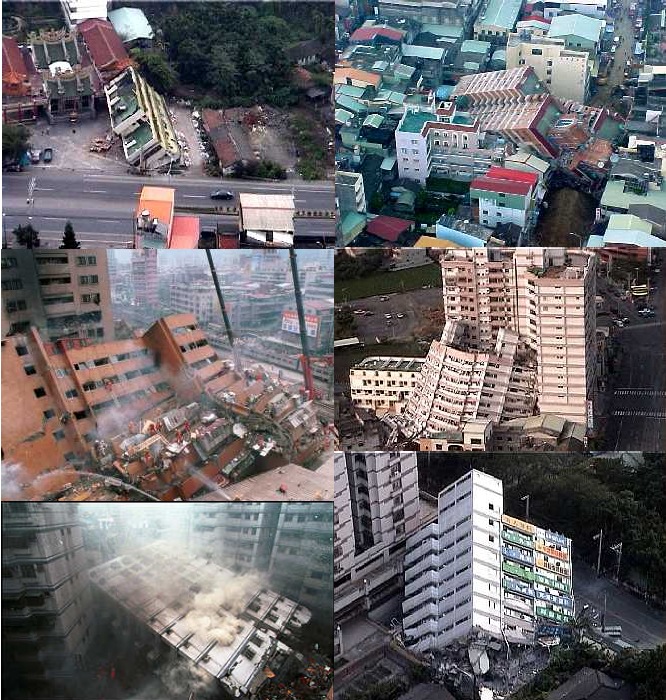 |
| Kobe 1995 |
But there is another way of looking at it, particularly if we shorten the time scale a bit. Whether you’re talking about a feudal castle, a one-story hovel, or an early-modern brick train station, most of the structures humans have recently called home are horrendously prone to complete collapse in the face of a serious quake. The past century has finally seen genuinely successful attempts to achieve some safety from this awesome force of nature. This isn’t just a matter of buildings, either – we’re also now enmeshed in global networks that allow both communication and direct relief to flow into devastated areas. This can’t save everyone, but it has already saved tens of thousands in the past few days. And then there’s education –as the Times poignantly points out, many of the dead in the southeast Asian tsunamis of a few years ago were swept out to sea because they failed to evacuate to safety, even though they had plenty of time. In Japan, evacuation was not complete, but it was still incredibly effective.
Obviously, we’re still far from secure (either on a day to day basis here in Tokyo, or on the larger scale of society as a whole), and it seems unlikely we ever really will be. But it also seems undeniable that the large-scale organization of human beings, in an explicitly hierarchical way, has produced huge gains in our collective safety. It’s also important to point out that this isn’t one of those situations where human beings are struggling to solve a problem that they themselves caused. Tectonic activity is simply something the earth does, with or without our influence. And while, all other things aside, the growing density of settlement makes the problem progressively worse, where do you draw that line? Again, a primitive dwelling is at least as prone to kill its inhabitants as a more ‘civilized’ structure, as the comparison between Japan and Haiti makes tragically clear.
 |
| Sendai 2011 |
I’m sure that anarchists of all stripes have answers for what their ideas would mean for the long-term developments of science, of architecture, of organized education, and of communication and mutual support networks. (And I don't mean to politicize this in some petty, short-term way - dealing with these real issues is why politics matter in the grandest possible sense, and I can't think of a more important time to talk about them). But having (at least for now) lived through a true existential threat to one of the world’s great civilizations, I find myself comforted by the embrace of Enlightenment. Maybe it’s the secular version of a deathbed conversion, but I would not have chosen to face the earthquake in a society less advanced, well-organized, and disciplined than Japan.
Tuesday, December 14, 2010
The Kafkaesque Absurdity of Japanese Paperwork
I had a rather eventful weekend, the less positive side of which was having my nice bicycle stolen (apparently by someone with a hacksaw and quite a bit of determination) from Koenji late Saturday night/Sunday morning. The upside of the crummy experience was that I got to feel quite good about myself after going in to talk to the police and rather uneventfully reporting the theft on Monday morning. Everyone I talked to was quite sympathetic and very helpful.
That was, for all its shadows, the good story. The bad one began when last week I decided to finally get settled back into a yoga routine, which I'd been letting slide. I found out when I first got here that though a recent yoga boom made studios pretty common, many of them - particularly those associated with the Yoga Lava chain - are women only. But, since yoga has proven so vital to me keeping on an even keel over the last two years, I decided it would be worth it to trek down to Shibuya a few times a week to the closest male-friendly spot (I was also planning to bike there frequently . . . oh, cruel irony!)
That was, for all its shadows, the good story. The bad one began when last week I decided to finally get settled back into a yoga routine, which I'd been letting slide. I found out when I first got here that though a recent yoga boom made studios pretty common, many of them - particularly those associated with the Yoga Lava chain - are women only. But, since yoga has proven so vital to me keeping on an even keel over the last two years, I decided it would be worth it to trek down to Shibuya a few times a week to the closest male-friendly spot (I was also planning to bike there frequently . . . oh, cruel irony!)
Subscribe to:
Posts (Atom)