Sunday, July 3, 2011

Red Bandana Lab, Ochiai Soup, 7/2/2011

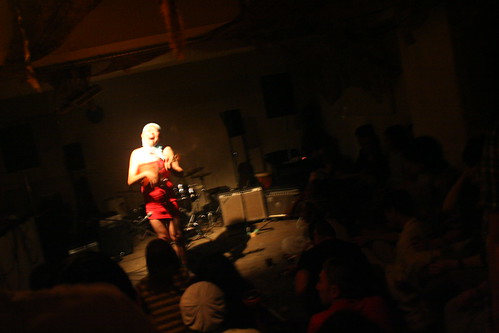
Had a really fantastic time Saturday at Soup, normally a home for experimental music, this time more focused on political messages and satire. The first act was a Ukelele/drag singer.  The prominence of broad drag on the Japanese radical left is something I've only just really noticed, and I haven't quite processed it. It's particularly interesting because the same scene is home to a higher-than-normal concentration of transgendered people.  It was a lot of fun and in good humor, but still I wonder how those in the audience (a couple) felt about seeing this:

June 2011

The main attraction was Red Bandana Lab, who I knew from their appearances at numerous sound demos going back years. They really blew me away, both with their otherworldly track selections and MC Yuso's furious styles.

June 2011

The event attracted a huge swath of Tokyo's radical left.

June 2011

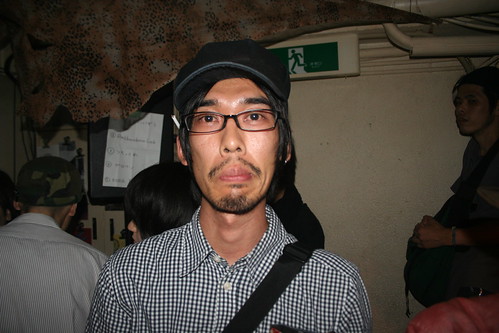
Kei of Irregular Rhythm Asylum

June 2011

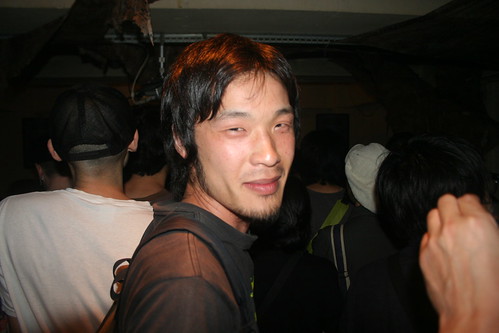
Taku from Shirouto no Ran

June 2011

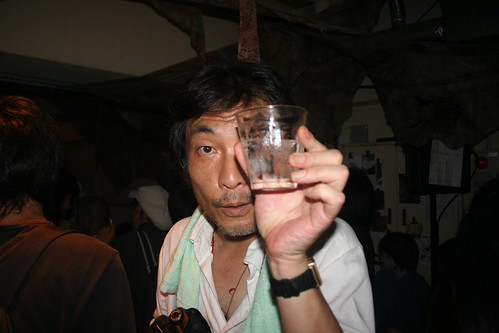
Photographer Goso Tominaga.  I wrote a mini-essay for a book of his pictures coming out sometime in the fall.

In conclusion, stay away from awamori, that stuff is dangerous.

Event Announcement: Understanding (and improving) Independent Music in Japan


From The Ground Up: Possibilities and Obstacles for Independents in the Japanese Music Industry

A conversation with Hiroki Sakaida of Pop Group Records

Toukyou Geijitsu Daigaku (Geidai), Kitasenju Campus, Lecture Room 1, 18:30-20:00, Tuesday January 12th

[I've put together a fairly informal event for next week, and I sincerely hope you can attend.  Information follows.]

In 2005 Hiroki Sakaida independently produced and released “Kaikoo,” a DVD chronicling the activities of a group of hip hop and electronic artists in Tokyo.  Building on the huge success of that release, he founded Pop Group records, which has become the home to a wide variety of artists, from hip hop to punk rock and R & B.  Pop Group’s aim and philosophy is to introduce innovative artists with an exploratory spirit into the Japanese mainstream.  With an entrepreneurial ethos and constant eye for new channels that can carry the label’s message, Sakaida has grown the business consistently over the last five years, including establishing the annual Kaikoo festival.

However, considerable obstacles face efforts to operate outside the traditional channels of the Japanese music business.  Many independent artists perceive an “indie glass ceiling,” a limit to success due largely to the cozy relationships between mass channels, such as television, and powerful artist management companies and large labels.  Independent labels such as Zankyou and Rose that have launched the careers of successful artists, but such cases seem comparatively rarer than in, for example, the post-Nirvana U.S. music market, where the route from indie to major is more well-worn.

In an informal conversation format, Sakaida will discuss his experience founding and expanding an independent label in Japan, and consider how infrastructure, policy, and culture have impacted his efforts to champion new aesthetics.  We will attempt to draw lessons from his experience about what changes to these conditions, if any, might make it easier to foster and spread adventurous Japanese popular music.

The conversation will be in Japanese, with English translation available as needed.

Saturday, July 2, 2011

Sleep of Ages - Hercules Against the Moon

Sleep of Ages - Hercules Against the Moon-Men by Sleep Of Ages

I've been trawling Soundcloud (or is that trolling?) while I do a last mad set of JLPT drilling.  This track in particular jumped out at me.  Of course, if you're not into noise, it's unlikely to connect, so enter at your own risk.

Wednesday, June 29, 2011

Glaciers of Ice: "DUBWIS6"

DUBWIS6 by Glaciers of Ice

I am legitimately proud of this.  I haven't got a clue how it happened.


Does it count as 'self promotion' if it's on my own blog?

Monday, June 27, 2011

Characterizing the Japanese Music Industry

I've been trying lately, as I move toward the end of my time in Japan (for now) to do a little summing up - to think about what I've learned, how I can structure it meaningfully, and what holes I want to plug before I leave.  Much of what I've learned revolves around the daily lives of musicians, but I want to place that within the broader context of the general conditions within which they're working.  So what can I say about Japan as a context for the production of music?  As an initial stab, the Japanese situation is one of:

1. Intense stratification and hierarchical control.  For musicians who want to reach a mass audience, there are no strong alternatives to the major labels and management companies.  For a variety of reasons (including strong-arm tactics by dominant management companies and, just maybe, high-level ties to organized crime), it is almost impossible to access television except through these channels. Where in the U.S. we've become used to seeing independent musicians on late-night talk shows, hearing their music on commercials, etc, there's no real equivalent to this in Japan.  Meanwhile, for musicians who bow to the structure, management companies tightly control their talent (even those with genuine musical talent), approving and limiting their releases as well as non-music projects.

Do you really even need to listen to this?
2. Partly as a result, there is Palpable Contempt for Mass Audiences.  This is not a cultural constant - Japanese pop music from the sixties and seventies was of high quality and often aesthetically or culturally progressive. But music of the recent past is simply insulting, pandering to an (admittedly often true) image of mouth-breathing otaku and blandly disinterested housewives. Of course, AKB is the apex of this (the recent CGI affair is only a rather patent manifestation of the plasticine idiocy they represent), but it's everywhere - teenage girls singing meaningless lyrics over cookie-cutter tracks.  Even artists who use visuals promising something interesting usually . . . aren't.

3.Thorough Domestication, at least at the top. The very biggest Western artists still get some traction (for instance, currently, Lady Gaga), and there is a genuine 'Korean Wave' of bands like Girls Generation.  And if you look at the culture more broadly, of course, there's a huge engagement with, in particular, Western (mostly American) pop, rock, jazz, soul, and hip hop from the fifties through nineties.  But charts are dominated by domestic artists. This might not be a problem, maybe not even notable, except that this insularity is self-fulfilling in the export market - the failure of the Japanese pop machinery to engage with global aesthetic developments over the last ten years has left Japanese pop relevant abroad only to a marginal, if not exactly small, group of international otaku. Again, this doesn't apply nearly as much to indie and underground acts, for example bands like Boris, Acid Mothers Temple, and Melt Banana who are active, relevant contributors to global music.
Monday, June 20, 2011

International Transport Volume 5A - Clean it Up And Dub It

Kaori 6.19.11 021
(The idea behind these mixes - of pointing out little-known American music for Japanese audiences, and vice versa - has been inconsistently executed.  But now we're doing it for real - this is part 1 of a matched set, and the second part should go up in no more than a few days.  This one's for my Japanese friends.)

International Transport 5 - Clean It Up and Dub It

ここに集まった欧米に作った曲には、最近も、ちょっと前の曲も入ているのに、ほとんどダッブの生気からインスピレーションもらった。The Weekndは基本的にR&B,ピーキングラライトスはIndie世界から来たん、HolyOtherは多分テクノと言うんだけど、三つは似ているようにダッブ芸実使う。

俺は最近得にテキサスをはじめアメリカの南から2000年代に出たヒップホップにはまっている。”Screw”と言うスタイルは日本にほとんど知られていないけど、最近サイケデリック世界にも音響している。特にSalemというバンドを影響された。スローはキーワード。いわゆる”Syrup”麻薬がこういう雰囲気の作るのに強い影響あった。 ”Still Tippin’”は私が一番好きのScrew風な曲。

ダッブや、Screw、「ノイズ」もこのミックスの中心です。ClamsCasinoと言う、日本にまだ知られていないトラックメイカーはノイズだらけ、けどフックも信じられない。同じ用に、ビッグジャッスの「Dedication 2 Peo」はある表面にきれいの逆けど、美しいになる。

Playlist Next

Thursday, June 16, 2011

Best Music Podcasts

Note: I now blog at Blownhorizonz.com.  It's much prettier to look at, and more focused on fun stuff like weird fiction, extreme music, and awesome art.  Also check out my Tumblr at blownhorizonz.tumblr.com.

As a city knit together by public transportation and lots of walking, Tokyo has made me more of a podcast junky than ever.  And of course, what I'm looking for most of all is music-related stuff.  Strangely, there's not exactly a wealth of greatness out there, but here's what I've found:

Sound Opinions (Itunes)

Sound Opinions is the only podcast I've found that actually engages with music, in the deepest sense - talking about it, interviewing musicians, reviewing history, putting things in context, and making critical judgments.  It's fantastic that it exists, but it's a shame it's so unique, particularly since its hosts are well into middle age, and while they tend to have a great sense of perspective, they're not very adventurous.

And if I can resurrect an outdated slur, they're the very definition of "rockists."

Gorilla Vs. Bear

Gorilla Vs. Bear is an amazing site, featuring new tracks daily.  But my favorite feature is the monthly mix, which compiles the best stuff from their posts.  It's a reminder of how nice it is to put your faith in an expert curator, against the current norm of always being your own DJ.

Altered Zones

Most of what goes for GVSB is true here too, except that Altered Zones hosts a series of guest mixers to produce their monthly mix series.  Recent standouts include John McEntire and Ford and Lopatin.

Experience Music Project Oral Histories (Itunes)

Not technically a podcast (it's part of ItunesU) but exactly the sort of thing I'd love to see more of - lineup includes conversations with Krist Novoselic and Henry Rollins.

Dublab (Itunes)

A series of live recordings by of-the-minute bands.  As the name implies, skews towards downbeat, lo-fi grooves. I can specifically recommend the great set by L.A. Vampires.

XLR8R (Itunes)

A pretty mixed bag, as they frequently (and surprisingly) throw in some rather lame rock, but I still dip into it every once in a while.


You might have noticed this is a rather short list.  It defies sense, but there's a genuine dearth of compelling and creative music podcasts.  If you have other suggestions, post them in the comments!