I was in the middle of a good Breaking Bad, and someone had to go and put something horrific in front of my face, so you might notice I'm in a foul mood. I really hope Carlin Romano wrote this piece for the money, and doesn't actually believe that today's college and high-school age kids are "the most distracted generation in history." Because, really, if a professor of . . . well, of anything, really, believes that Twitter constitutes a greater threat to a generation's ability to sustain interest in an entire book than did, say, pneumonia epidemics, the lack of indoor plumbing, mass migrations, two World Wars, and the Dark Ages . . . let's just say it's fitting how little responsibility the article places with instructors and administrators.
Technophobic hysteria is just as pathetic as techno-utopianism, and both are that much worse when we get our facts wrong, as Romano does when he alludes to declining book sales - they increased by 1 percent in 2008 and dropped 2 percent last year, a period in which unemployment rose by roughly 100%. This is pretty much the opposite of apocalyptic, and shows just how big a reality gap Romano is wrestling with. His sociology is just about as loose as his statistics, as he piggybacks on observations by Robert Darnton (and, of course, many unnamed co-conspirators) that these kids today do not have the "concentration, endurance, the ability to disconnect from other connections" required to really read books.
I'm not going to argue with this observation. Young people today ARE a distractable, lazy, shiftless lot. But Romano and Darnton alike make a terrible, terrible mistake when they blame this on technology, or in fact on anything other than human nature. Young people are distractable, lazy, and shiftless by nature, in general, and while I don't have the hard data ready to hand, I'd be willing to bet they've been so pretty much throughout history. Oh, except for whenever Ramano and Darnton were growing up, since every one of their classmates went on to write at least one influential essay for Harper's. Right?
What has changed isn't that kids are stupider. What has changed is that more people are going to college, and not all of them are inherently interested in the stuff humanities professors love to teach, and there are also more humanities professors without the drive, energy, or ability to cultivate that interest (though some of them apparently have leftover time in which to write articles and books blaming society for their failure to do their jobs). To try and paint a picture of a society in decline based on a comparison between the average level of today's students and of those of the past would be absurd even IF those past universities really had been idyllic havens of seriousness. Which would require that Romano and Darnton hadn't based their implicit cultural history on Dead Poet's Society.
The discipline and effort required to think in a sustained and engaged way has always and will always be hard-won. If it weren't, there wouldn't be millenia-long traditions of mental discipline rooted across the globe, and there wouldn't be such respect, even reverence, reserved for those who master and refine them. If it weren't, we wouldn't need either of the two European versions of the struggle for self-cultivation - if we were anything other than a bunch of foot-tapping monkeys who nonetheless aspired to greater things, neither the church nor the university would have any place. This is the most disturbing part of Romano's little traipse: while he skillfully dances between taking a technophobic stance and merely documenting and summarizing the technophobia of others, he makes absolutely no connection between the "cultural condition" he purports to diagnose and the mission of the university and college instructors who make up his audience. By talking about "Generation Text" so neutrally in a forum like the Chronicle, he is helping to create them. By cynically giving students a generational pass on caring, he's helping rob them of the sense of worldly responsibility that will (eventually, I swear it happens) turn them into adults.
Some of the greatest literature and philosophy of the last two centuries was written by people who only owned one suit of clothes, lived in squalid tenements, and/or were slowing losing their minds to syphilis. There has never been a time in human history when we were more able to comfort and support students and scholars. I don't personally agree with the premise that our children, is they not learning? But if I'm wrong and Romano's right - if from all of this plenty coming generations prove unable to better or match their forbears in serious engagement with art and thought - we will need to look for an explanation deeper, and likely more disturbing, than Facebook.
Monday, August 30, 2010

Saturday, August 28, 2010



Wednesday, August 25, 2010
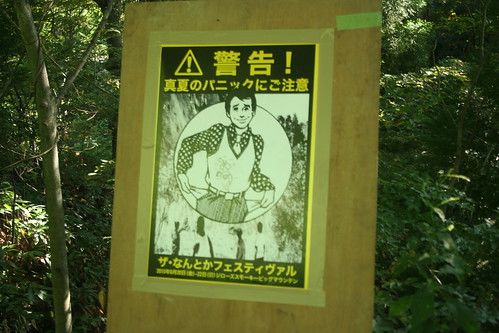
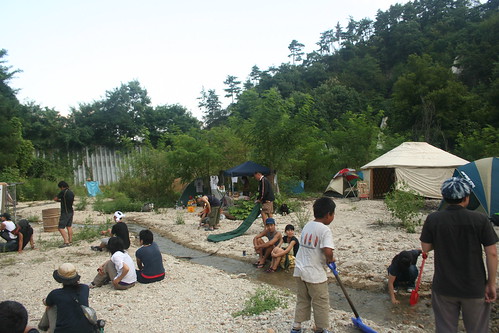
Photo Tour: Nantoka Fes 2010
I don't have much to say right now about last weekend's Nantoka Fes, so I'm going to limit myself to a selection of images. If you're curious for context and commentary, stay tuned to this space. Several more pics after the jump.

Avatar Links
Mostly for my own benefit, I'm throwing up a few links here to very good pieces (written, of course, several months ago) about Avatar. Hopefully I'll be able to use them for the panel discussion about technology I've got coming up.
Avatar and the American Man-Child
Avatar: The Density of Being
Avatarship and the New Man: Reading Ideology, Technology, and Hope
Panthea vs. the Capitalist War Machine
Avatar and the American Man-Child
Avatar: The Density of Being
Avatarship and the New Man: Reading Ideology, Technology, and Hope
Panthea vs. the Capitalist War Machine
Tuesday, August 24, 2010
Academic Cliche Watch: "I want to argue that . . ."

Like "In particular ways," "I want to argue that . . ." is completely unnecessary verbage that gets in the way of the meat of a statement. If you cut the phrase out of any sentence that it begins, the thrust of the sentence doesn't change. To wit:
- "I want to argue that Avatar provides a completely unearned and politically counterproductive catharsis for white, Western guilt over colonialism and racist exploitation."
- "Avatar provides a completely unearned and politically counterproductive catharsis for white, Western guilt over colonialism and racist exploitation."
The comparison makes clear that while "I want to argue that . . ." adds nothing to the content of the first sentence, it does have a function - to make the claim seem more cautious and hedged. It's the academic equivalent of "Well, this is just my opinion, but . . ." The problem is that if you want to be a responsible academic, you can't hedge, soft-pedal or whisper. You have to stand behind your claims, and "I want to argue that . . ." signals that you're unwilling to fully commit. In short, the phrase is a way for intellectual cowards to shirk responsibility for the words that dribble out of their mouths and pens.
Doubts about Open Peer Review
The NYT published a piece on Monday about prospective changes to the peer-review process. The core idea being floated here - and being put into practice by The Shakespeare Quarterly - is something roughly like crowdsourcing the peer review process. The SQ filled an issue with pieces constructed by posting drafts online, then submitting them to comment from a wide circle of registered users, whose feedback was posted under their real names. Having recently completed a really long, grueling trip through the conventional review process, I'm certainly primed to see the good in these new models, and there's a good bit of it. In particular, open sharing of ideas and fast turnover both seem like good ideals to strive for. On the other hand, it seems to me there are at least some potentially serious drawbacks to this sort of process:
-Reducing Negative Comments - I'm personally not afraid to publish negative feedback under my own name, but I know that many are, and such comments are arguably the most important part of the process. My first attempt at submitting my manuscript was met with pretty harsh feedback, and it provided me the motivation to take a serious second look at the piece and subject it to aggressive revisions that made it better. Some argue that we should be looking for a more supportive and less aggressive model for the academy, and non-blind review would support that, but I personally don't think coddling people's feelings should be even an unintended consequence of change - we need higher standards, not lower.
-Collective (Ir)Responsibility: How much work will participants be willing to put in if both the responsibility and the recognition for service are spread among 350 people? Academics, fairly or not, constantly complain about overwork and not being able to find time for their own research. If there's even the thought in their mind that 'someone else will do it,' won't we have a tragedy of the commons situation? On the other hand, some reviewers in the current system are apparently not all that conscientious - but at least in theory, editors and the community at large eventually figure out who those people are. It's much more difficult to spot the shirkers in an open structure.
I'll be interested to see how this sort of experiment develops, but I think the key to correcting problems is a much more fundamental recognition that not everyone in the academy is capable of turning out meaningful, original research. As soon as we readjust our expectations and provide options for people to prove their worth to institutions in other ways, at least one of the problems that Open Peer Review are designed to solve - for all the talk about sharing, they're also about addressing the problem of overloaded reviewers - will fade, as the process gets less clogged with sub-par work from uninterested researchers who are churning stuff out out of professional obligation rather than actual creative drive.
-Reducing Negative Comments - I'm personally not afraid to publish negative feedback under my own name, but I know that many are, and such comments are arguably the most important part of the process. My first attempt at submitting my manuscript was met with pretty harsh feedback, and it provided me the motivation to take a serious second look at the piece and subject it to aggressive revisions that made it better. Some argue that we should be looking for a more supportive and less aggressive model for the academy, and non-blind review would support that, but I personally don't think coddling people's feelings should be even an unintended consequence of change - we need higher standards, not lower.
-Collective (Ir)Responsibility: How much work will participants be willing to put in if both the responsibility and the recognition for service are spread among 350 people? Academics, fairly or not, constantly complain about overwork and not being able to find time for their own research. If there's even the thought in their mind that 'someone else will do it,' won't we have a tragedy of the commons situation? On the other hand, some reviewers in the current system are apparently not all that conscientious - but at least in theory, editors and the community at large eventually figure out who those people are. It's much more difficult to spot the shirkers in an open structure.
I'll be interested to see how this sort of experiment develops, but I think the key to correcting problems is a much more fundamental recognition that not everyone in the academy is capable of turning out meaningful, original research. As soon as we readjust our expectations and provide options for people to prove their worth to institutions in other ways, at least one of the problems that Open Peer Review are designed to solve - for all the talk about sharing, they're also about addressing the problem of overloaded reviewers - will fade, as the process gets less clogged with sub-par work from uninterested researchers who are churning stuff out out of professional obligation rather than actual creative drive.
Monday, August 23, 2010
Brian Eno on Warp Records
I don't have much to say about this, but it's worth a look.
There are pictures of the most beautiful boxed set of a single album I've ever seen. If labels want to learn about how to make physical albums lustworthy, must-buy items again, look no further. And the inclusion of CD, vinyl, and download versions of the album in one package is exactly what real music fans want, and will pay through the nose for.
There are pictures of the most beautiful boxed set of a single album I've ever seen. If labels want to learn about how to make physical albums lustworthy, must-buy items again, look no further. And the inclusion of CD, vinyl, and download versions of the album in one package is exactly what real music fans want, and will pay through the nose for.
Subscribe to:
Posts (Atom)