This is roughly my 200th post at Minds Like Knives - I have several unpublished drafts that Blogger counts as posts, so I can't be quite sure, but since I'm excited about this post (as opposed to the alcohol reviews preceding it) let's call it number 200. Yaaaaaay! Now on to the dismemberment.
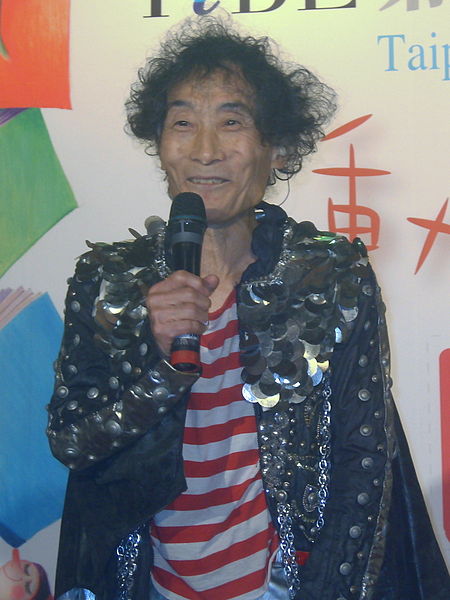 |
I doubt he dressed like this in the fifties.
Or for that matter, the eighties. |
Kazuo Umezu is a weird one - not just a weird guy, though he would seem to be that, but a weird career arc, which somehow links into the weird arc of Japanese culture over the last fifty years. His first well-known work, and still considered something of a minor classic, is
Nekome Kozo, or
Cat-Eyed Boy. It's a spooky but fairly innocent story about a supernatural child who goes around bumping into ghosts and spiders and assorted lighthearted symbols of the weird and scary, in a halloween-childish sort of way. It's honestly not to far from what you'd imagine Miyazaki would come up with if he was contracted to write a "ghost story."
But as time went on, Umezu was given the opportunity - maybe even the impetus - to explore some profoundly dark places. I recently picked up
'Kami no Hidari-te Akuma no Migi-te' ('God's Left Hand, Devil's Right Hand'), and it contains three of the more deeply unnerving stories I've come across this side of Lovecraft. Moreover, these are stories that, if not actually intended for children, maintain (intentionally or not) many of the tropes of children's literature, leaving the adult reader with the impression that they've come across something that quite possibly deserves to be banned or burned - except it's four decades too late.
This is the first page of 'Kami no Hidari-te.' It requires a little context - you see, this is a nine year old girl getting her eyes gouged out by a pair of scissors
from the inside. It turns out this is a dream sequence, but generally Umezu doesn't pussyfoot or dodge the disturbing elements of his stories. Most notably, the second story in 'Kami' begins with the totally unprovoked plot of a group of third graders to brutally murder their teacher so they can "see her true character" after she dies. Child characters prove themselves capable of astonishing violence again and again in this book - sometimes heroic, just as often cruel and malicious. And even the 'heroic' acts are often justified in ways that would get real-world kids locked up - for instance, setting a bear trap in a woman's car because of something seen in a dream.
The grotesque sequences just keep coming, and if you've got a taste for artful shock, they alone will keep you engrossed. For instance, while it's been done to death since (see Stephen King's cockroaches), one might consider these sequences of full-body spider infestation visionary.
What elevates 'Kami no Hidari-te' beyond mere shock, though, is the narrative surrealism. In many cases, the conciets are hard to summarize, which in my book is an endorsement. In the first of the three stories, an extended set piece revolves around the idea that 1) a young girl is being possessed by the vengeful spirits of murdered children, 2) the inside of her body has become a battle ground between those children's murderers and the young girl's brother, who is some kind of dream-warrior, and 3) the dead children are ejecting everything from newspapers to tricycles through her into the world, without killing her.

It's gory to an almost mind-numbing extreme, but the plot keeps things moving along and never allows any image to get stale. The same effect holds throughout the book, especially in the third story, which involves the genuinely surreal and delightfully unexplained flexibility of the boundary between dream and reality. The protagonist (the same young boy from the first two stories) at one point enters a dream state, transforms into a crow to kill a spider-queen by ripping her tongue out, and then awakes to spit out the mangled corpse of a spider.
And as I said, what's most insane about all of this is that it relies so heavily on conceits that imply that the intended audience is preteen. The same young boy character (Sou, meaning roughly "idea") is the protagonist of all the stories. His older sister never believes him when he says he's seen something (in a dream or reality, which ultimately become interchangeable), and adults, similarly, seem to distrust something about him. Both of these (like the inarticulate adults of 'Peanuts') seem intended to appeal to actual ten year old boys. Sometimes the kid protagonist is actually right, but then there's also the time that he murders his third-grade teacher,
in the real world, without any remorse or consequences.
In short, if it was ever actually intended for children, this is a deeply fucked up book.
If we're talking about adults, though, it's amazing and highly recommended. This is a recent reprint, with this kickass day-glo cover and a lot of rich and varied partial to full color schemes scattered on the newsprint within. It's a fat book, but even with my middling Japanese it's a pretty quick read (and that's actually another disturbing point, because the simplicity of the language seems to have too-young readers at least partially in mind). Ultimately, if you're sick in the head and enraptured by monsters, death, infestation, mutation, and body trauma, this is an absolute must-have.