Showing posts with label the city. Show all posts

Monday, December 5, 2011

Ritual Unrest - On the Symbolism of Occupation


On the evening of Thursday, December 1st, at about 8pm, a group of about 150 people operating as Occupy Tampa conducted a march from Curtis Hixon Park in Downtown Tampa to Julian Lane Riverfront Park.  After arriving at Julian Lane, members of the group held a meeting at the park’s ampitheatre and collectively agreed to establish an encampment there.  The group then moved to a small hill, where they pitched a handful of tents.  At 10:56 pm, 13 unmarked Tampa Police Department squad cars pulled into the parking lot of Julian Lane Park, and around 30 police officers moved into the park.  They issued a warning to the group of campers that they were trespassing in the now-closed park.  After allowing several members of the group to exit willingly, the police surrounded those who refused to leave.  Two hours later, 29 people had been arrested for trespassing and, in many cases, resisting arrest.

These facts, like most, do not speak for themselves.

Monday, May 23, 2011

Regarding Workers

Post-Quake 038

I took the above photo a couple of days after the 3.11 earthquake, mainly to illustrate the amazing speed with which Tokyo returned to everyday normality. The guy in the middle is just one subtype of an eternal Tokyo presence - the sidewalk promoter. He's giving out flyers (and probably tissue packages) to promote a contact lens shop, but you'll also see people doing much the same work in service of Italian restaurants, Karaoke boxes, manga kissaten, Korean barbecues, and hostess clubs (including the vile subspecies who harass passing young women to try and lure them into the sex industry).

I've lately been thinking about how little I understand the human element of a job like this. It's just one of a variety of undeniably crappy jobs you see people doing every day in a city like Tokyo, from fast-food server to Donki clerk to construction-site traffic-director.  The last time I worked a job of this sort was about a year ago, when I did short stints as a parking-lot attendant and line-cook as part of my confused attempts to deal with unexpected funding shortfalls in my last year of grad school.  Both were part-time jobs, and the line cook job was actually a hell of a lot of fun, but  I ended up quitting both jobs with no notice in moments of frustration and/or overwork.

I had that option, because I knew I was on my way to other things, but I was nonetheless able to hold onto some (facile, superficial) sense of solidarity with "workers," thanks to my cushioned, provisional version of poverty, and the genuinely merciless grind of grad school, in some ways undeniably more demanding and even exploitative than this sort of service job.

Now, though, I'm realizing how much that illusion of lived solidarity was insulating me from a real consideration of the challenges posed by living in a mercilessly stratified society.  Job-wise, I'm now living a ridiculous fantasy, which if not quite financially secure does happen to include total freedom.  I'm suddenly not sure how to feel about the legions of workers through whom I float, to whose daily struggle I find it more and more difficult to truly relate.

Saturday, April 30, 2011

Evil's Advocate: Why Nike's Miyashita Park is a Good Thing

I consider myself a leftist, but there are a lot of pieties and givens on the left that I don't quite swallow whole.  In fact, I sometimes find myself sketching positions that are at least contrarian, if not retrograde.  The thing is, I wish someone would convince me that I'm wrong about these fleeting hints of conservatism.  This is the first installment of a new occasional series, Evil's Advocate, in which I invite friends of the blog to tell me exactly why my thought crimes against progressive ideology are misguided.

After years of organized opposition to its extensive reconstruction, Shibuya's Miyashita Park has finally re-opened.  It's a tiny strip of elevated land parallel to JR Shibuya station.  Prior to the renovations, the park was a typically depressing Japanese park, not much but packed dirt, some playground equipment so dilapidated I wouldn't let any child of mine within ten yards of it, and about two dozen permanent homeless residents.  Now, it has become . . . this:


So, how could this transformation from moribund and dreary to active and useful be a bad thing?  The root problem for hundreds of activists who have spent a lot of energy opposing the changes seems to have been that they're all planned and executed, not by Shibuya City, but by Nike.  Initially, Nike was to pay the city a large sum of money each year for a decade for the right to officially rename it "Miyashita Nike Park."  Through demonstrations and direct action, the activists seem to have successfully stopped the renaming - when I went yesterday, there was no Nike branding on any signage, all of which simply said "Miyashita Park."  Even though this seems to have been the activists' only real victory, it's not a small one - for park users and residents to have it constantly shoved in their faces that Nike had essentially taken over a public park would have certainly had insidious long-term effects on whatever slim awareness of the idea of public space may remain in Tokyo.

But without the imposition of corporate ownership, what impact does this reconstruction have on the idea of public space?  In the pictures above, you'll see a healthy mix of people of all ages enjoying themselves, and most importantly, interacting outside of the confines of traditional work or school settings.  It may not be explicitly politicized, but as anyone who lives in Tokyo can tell you, this is still deeply political.  People from different walks of life are almost never brought together in relatively unstructured play environments, and it seems certain that the new Miyashita Park will act to strengthen social ties among area residents.

And the place truly is accessible to all.  There are fees for using the facilities, but they're almost nominal: 200 yen for skating and 350 for climbing, about $2.50 and $4.50 U.S. respectively.  Futsal court rental runs from 4000 to 6000 yen per hour, but with two sides of five players, that breaks down to about 600 yen, or seven dollars, per player.  Especially in Tokyo, these are truly trivial amounts of money, just enough, I would say, to guarantee that those using the facilities will take some responsibility.

A second major issue for the activists was the forcible ejection of the homeless during construction of the park, and the suspicion that they would not be welcome in a new, corporate-sponsored park.  (This complaint might be hard to understand from an American perspective, but here in Japan it's quite common for homeless residents in parks to be tacitly or even explicitly tolerated by authorities).  I have mixed feelings about anti-camping laws: at least in the U.S., many homeless people truly need help, either with mental illness or substance abuse, to the extent that they're dangers to themselves and others.  This seems to be slightly less true in Japan, mainly due to stronger familial safety nets, but it's nonetheless the case, particularly in a space as small as Miyashita, that campers made the park less usable for other people.  In other words, homeless or not, they were using more than their share of a public resource, and using it in a way that interfered with others' enjoyment of it.  While for the homeless, living in the park is probably nicer than being in a homeless shelter, I think that in this case it wasn't fair to the general public, and the park is now a greater public good.

Finally, activists objected, over and above the naming issue, to corporate control of the park.  This is where I am likely to really clash with some of my friends - I think that it's great that Nike took the initiative to make this space more usable.  This is especially true since, generally speaking, Tokyo's wards and the Japanese government are extremely bad at maintaining parks.  Their manufacturing practices may be traditionally abhorrent, but Nike as an entity and a culture clearly has a far better sense of what people want to do for fun than anyone in any branch of Tokyo's metropolitan government, most of whose idea of fun is probably getting shitfaced in a no-panties hostess bar and charging it to public accounts.  Japanese people have a huge love of outdoor activity, and cultivate it despite the almost uniformly lackluster provisions for things like soccer in Tokyo's public parks.  If it takes a corporation to come in and do a better job, then so be it.

Just to reiterate, whatever good I think has come of this, the role of the activists was crucial.  Everything good about the new Miyashita Park would have been rendered bitter and destructive by having Nike's name plastered all over it, and it's hard to say what the park might have ultimately looked like without their pressure.  But now that it's quite literally a fait accompli, it's not fair to hold a grudge and completely deny the possibility that something good resulted.  After all, I'm willing to bet some of those protesters like to skate.

Sunday, March 13, 2011

The 2011 Great Touhoku Earthquake: Civilization and Enlightenment Triumphant?

UPDATE: As the New Yorker has pointed out, early casualty estimates have turned out to be vastly short of reality.  This piece was written back when we still thought we'd dodged a bullet, and I'm going to let it stand as evidence of that moment.  More commentary on the process of unfolding knowledge, however, will be forthcoming.

Three days ago I lived through what has now been confirmed as one of the largest earthquakes in recorded history.  Luckily, I was a small but crucial distance from the epicenter, in Tokyo, but the ground here still rolled and tumbled in a way that even Japanese people had never felt before.  For the two or three minutes of the quake, I stood in the doorframe opening onto my porch, watching the tangle of power lines passing along the street sway crazily.  It seemed not just possible, but probable that one or more of the complicated systems that sustain this mass hive of human life would come crashing down, its shards spreading death and destruction.
Tokyo 1923

That didn’t happen – Tokyo stands now almost as if the quake never happened.  Just a few crumbled facades, quickly covered with neat tarps and scaffolding, remain to indicate what happened.  For the moment, we’ve been lucky – by the time it got to Tokyo, the quake was only about a 6.0 magnitude.  But there’s no guarantee that a quake of equal or greater magnitude won’t hit Tokyo more directly, within the next couple of days.  This means we could all be in a new, unpredictable situation with little or no warning.

But what exactly is that situation?  The last major Tokyo quake, the Great Kanto Earthquake in 1923, struck a much different society.  Compare that quake, a magnitude 7.5 which killed between 100,000 and 140,000 people out of a regional population of 7 million, and the 1995 Kobe quake, a 6.8 in which 6,000 people died out of a total population of something like 1.5 million (That’s the 2006 census number, as I couldn’t quickly find data from the mid-1990s).  The earlier quake killed something like 2% of Tokyo’s population.  The latter, less than 1/10th of 1% of Kobe’s. 

There are too many variables to make the comparison airtight, but it’s obvious that many things changed in the intervening years.   The New York Times did a good job of summing these up – they include training and preparedness, but most important of all is a dedication to buildings that can withstand major quakes.  For anyone who felt Friday’s quake, the fact that Tokyo is standing now is nothing short of a miracle – the way the earth kicked, it seemed like a power pole would have little chance to withstand it, much less a ten-story building.  Even since 1995, the government has stepped up regulations and pressure, which means that unless something pretty extreme hits Tokyo almost dead-on, the damage, while significant, is unlikely to be as cataclysmic as it was in 1923.

Lately, I’ve been thinking a fair amount about a fundamental question – is civilization itself a good or bad idea?  Much prodding has come from my (still pretty limited) reading of Jonathan Zerzan, a major figure in the movement of ‘green anarchists’ who advocate, very broadly, the reversion from advanced capitalism to some modified form of hunter-gatherer society.  As I sit here, waiting for a disastrous quake that could come at literally any second, I’m turning this idea over in my head, still unsure what the quake might make clear.  On the one hand, most of the risk of death in a quake comes from collapsing man-made structures.  More generally, we have built up such a complicated, crowded, and delicately balanced system that it is easier than ever for something like this to cause dramatic losses.  Think about what northern Japan would have been like on Friday if there were no factories, no buildings, and only a few thousand people - it’s clear there would have been nothing like the mass destruction we’ve witnessed.  Quite simply, the level of suffering would have been much, much lower.
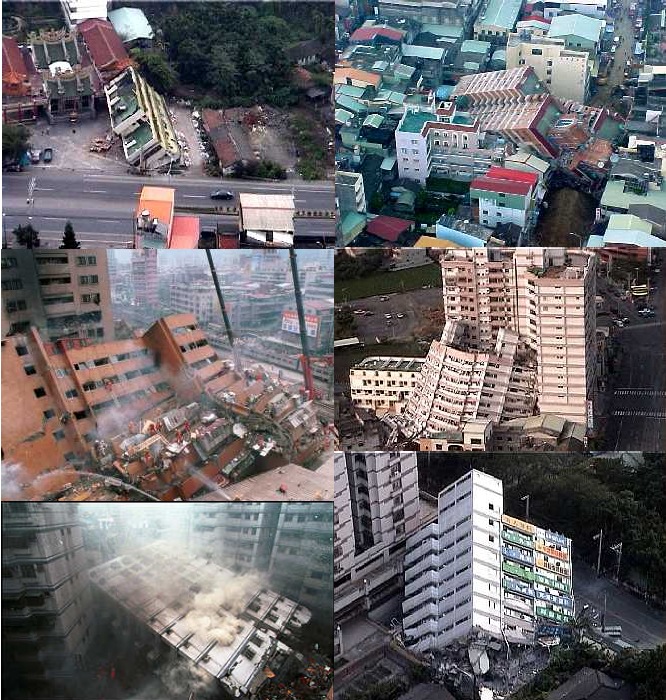
Kobe 1995

But there is another way of looking at it, particularly if we shorten the time scale a bit.  Whether you’re talking about a feudal castle, a one-story hovel, or an early-modern brick train station, most of the structures humans have recently called home are horrendously prone to complete collapse in the face of a serious quake.  The past century has finally seen genuinely successful attempts to achieve some safety from this awesome force of nature.  This isn’t just a matter of buildings, either – we’re also now enmeshed in global networks that allow both communication and direct relief to flow into devastated areas.  This can’t save everyone, but it has already saved tens of thousands in the past few days.  And then there’s education –as the Times poignantly points out, many of the dead in the southeast Asian tsunamis of a few years ago were swept out to sea because they failed to evacuate to safety, even though they had plenty of time.  In Japan, evacuation was not complete, but it was still incredibly effective.

Obviously, we’re still far from secure (either on a day to day basis here in Tokyo, or on the larger scale of society as a whole), and it seems unlikely we ever really will be.  But it also seems undeniable that the large-scale organization of human beings, in an explicitly hierarchical way, has produced huge gains in our collective safety.  It’s also important to point out that this isn’t one of those situations where human beings are struggling to solve a problem that they themselves caused.  Tectonic activity is simply something the earth does, with or without our influence.  And while, all other things aside, the growing density of settlement makes the problem progressively worse, where do you draw that line?  Again, a primitive dwelling is at least as prone to kill its inhabitants as a more ‘civilized’ structure, as the comparison between Japan and Haiti makes tragically clear.

Sendai 2011

I’m sure that anarchists of all stripes have answers for what their ideas would mean for the long-term developments of science, of architecture, of organized education, and of communication and mutual support networks.  (And I don't mean to politicize this in some petty, short-term way - dealing with these real issues is why politics matter in the grandest possible sense, and I can't think of a more important time to talk about them).  But having (at least for now) lived through a true existential threat to one of the world’s great civilizations, I find myself comforted by the embrace of Enlightenment.  Maybe it’s the secular version of a deathbed conversion, but I would not have chosen to face the earthquake in a society less advanced, well-organized, and disciplined than Japan.

Monday, December 6, 2010

Tokyo Sound Catalog 1

Sounds You Will Not Hear in Tokyo:

  • Arguments in the Street
  • Catcalls
  • Honking (Exception: Very occasionally, a taxi)
  • Conversations between strangers (especially aboard trains.  The more crowded they are, the quieter).
  • Apologies between people who have bumped into one another or otherwise violated personal space (Replaced by nods, bows, glances).
  • Conversation on a crowded train
  • Individuals’ music (e.g. boomboxes, loud headphones)


Sounds You Will Hear in Tokyo:

  • Formalized routine sales pitches, recorded music via loudspeaker (in commercial districts)
  • Loudspeakers blaring from moving trucks (in residential areas – electronics resale shops; in busy centers – right-wing hate speech)
  • The rattle of passing trains
  • The klaxons of train crossings
  • Beeps (crosswalks, backing trucks)
  • Happy chatter (only late at night, after patrons begin leaving bars and cafes)

Friday, December 3, 2010

The Infinite Tragedy of Awesome Bookstores


Going into a really good bookstore makes me strangely sad.  I was recently at San Francisco's Green Apple Books, and all I could think about was the fact that I could never hope to read all the great books that were laid out tantalizingly before me.  Thank god, then, that my Japanese reading is as poor as it is - Tokyo is full of bookstores of such size to bring on body-wracking sobs of desperation.  On top of that, they're cheap enough that the temptation to add just one more ridiculously cheap book to the pile can be overwhelming.

Today's haul was from the Book-Off in Akihabara, which has a small but cheap and, as you can see, occasionally spectacular English section.  All of the English books were Y200 each, except for the Alex Garland, which was Y105.  The Kobo Abe is a book I desperately needed, very specifically, for my current work.  The brown one you can't see is Natsume Soseki's Botchan, a classic of the transition from traditional to modern Japan - and both of those, again, Y200 each! The two Japanese hardcovers - by Ryu Murakami (top) and Haruki Murakami (bottom) were also Y105 each.  remix is an excellent, thoughtful hip hop and electronica magazine. Or, more properly, it was - it was recently bought and remade into a more commercial outlet.  I'm buying up all the back-issues I can get my hands on, particularly those featuring interviews with Japanese hip hop acts.  The issues here have interviews with Scha Dara Parr, Big Joe, Mic Jack Productions, and Muro (from 1999!).  The most expensive thing in the whole stack is at the very bottom, a remix featuring an interview with Sapporo's The Blue Herb.  And this was all just in an hour!  It's enough to drive you to drink - or at least that's my excuse.

Monday, November 29, 2010

Notes Towards a Cultural Geography of Tokyo

Gaston Bachelard
I don't want to make it a general habit to put my research notes up here, but for the moment I'm a bit out of pocket, and I suppose occasional glimpses of the work in progress can only help.  As some of my recent posts have suggested, what I'm gravitating towards right now is a full-scale psychoanalysis of Tokyo as a spacial/mental construct.  In SF, at the amazing Green Apple bookstore, I happened across a book that I think is going to be vital to that effort - Gaston Bachelard's The Poetics of Space.  I wanted to get down a few thoughts that the book has triggered so far.

First of all, Bachelard's book is about the way the poetic image shapes our experience of space, and since my chapter is going to be part of a book about hip hop, the obvious and correct move is to integrate readings of how space is represented in Japanese hip hop, both lyrically and musically.  There are the broad categories of space representation in hip hop as a whole, then the specific ways this is implemented in Japan.  Immediately, it occurs to me that space in hip hop has two particularly important modes - the space of the 'hood, and the space of the club, both of which emerge both sonically and lyrically.  There's the spacial extensiveness of bass music, which can either flood out over a city block, or reverberate inside the box of the club, filling the body, going inward.  In Japanese hip hop , the hood gets represented in the work of Shingo Nishinari (named after his Osaka neighborhood) and MSC (whose song "Shinjuku Running Dogs" talks about Kabukicho/Nishishinjuku as an "unsleeping terminal").

The issue of place as a site for identity attachments was never a major component of psychoanalysis, and Bachelard makes the vital point that this leads frequently to the confusion of shifts in location for time's passage in human development.  Time and space are, if not interchangeable, then mutually dependent.  So aside from the music and lyrics, the chapter needs to look at the history of the city itself, from a psychoanalytic perspective of digging down into the layers below the street, as I did in my recent post about the firebombings. The city of Tokyo is a storehouse of memory, even though (actually, specifically because) so much of it is newly built.

This is also significant because time, space, and identity are so closely linked in Tokyo, in Japanese society more generally, and in particular in the Japanese attitude toward subculture.  For many here, participation in a subculture is something literally 'left at the door' when moving from subcultural spaces to professional or more generally social spaces.  So, space becomes not just the marker but the root of changes in identity.

Monday, November 22, 2010

The Geography of Surface and Depth: San Francisco and Tokyo

The San Francisco underground – at least the part of the BART that I rode inside the city proper – is really terrible. There are no maps near the ticket machines, no audible station announcements, no signs with station names easily visible from the train at stops. If you want to know how to make the train less convenient and accessible than the bus, come to San Francisco. It's one stark contrast with Tokyo, whose subway organization and labeling is relentlessly clear and logical, down to a multilingualism that makes it potentially transparent (after a certain learning curve) to an array of foreigners.

The contrasts in the two cities' landscapes are layered and transverse. At the very surface, SF is a beautifully mystified city – a mosaic of murals, creative storefronts, beautiful century-old brass scrollwork, window displays, public art. By contrast, while I don't have a great deal of personal grounds for comparison, others before me have described Tokyo as one of the drabbest, if not outright ugliest, of the great cities. Its parks are scraggly and unkempt, and as much as they are romanticized by a certain American subset who fetishize their “postmodernity,” the unregulated trammel of racing neon lights, dirty plastic mascots, and frantically spinning tin signs amount more than anything to an unending eyesore. There are the struggles of a small few humanizers – graffiti artists and creative boutique retailers fighting the grey concrete and off-white tile, the textural regularity of the cheap and mass-produced buildings – but the fight, against indifferent ward governments and citizens long cowed into aesthetic submission, is one they can't win.


But at another level, the roles reverse. Beneath its surface vulgarity, for instance if we travel the paths of its streets and experience their flow, or even just look at a map of any random section of the 23 wards, we can see that Tokyo's humanity and chaos are inscribed at a deeper level. The map to the right happens to be of Shibuya, but shows a familiar pattern – a major hub towards which major streets and minor lanes alike converge, inconsistently, with kinks and swerves, revealing the trace of pedestrians and rickshaws and palanquins carving them by consensus over the course of a century or three. Streets bend and spiral, both at the level of the block and the level of the city as a whole.

Saturday, November 6, 2010

The Pigeon Artist

It is right now 7am or something in Nakano, the sun coming up and telling us that all good boys should have been in bed.  You know, some time ago.  Instead I was in Roppongi until six a.m.  Towards the end I helped pile a half-coherent fifty year old political scientist into a cab as two Japanese women who'd joined us vaguely described his destination to the driver and we all crossed our fingers.  We refueled and exchanged phone numbers.  The best new friendships are born under fire.

But even better, as I walked back from Nakano station to Arai, along some half-paved side road,  I saw a man performing magic.  He was on top of an apartment block, waving a green, yellow, and red signal flag.  And as he waved the flag, a flock of pigeons moved around him, with infinite grace, like tamed lightning. They circled the building's top, again and again.  I stood and watched for ten, fifteen minutes, the very early morning traffic moving around me.  This was something practically supernatural, the mundane fabric of the city flicked to one side to reveal an oddity, creatures out of fantasy, made real through vision and not a little discipline - this must have taken decades to master. I was listening to this band called Dr. Dog who make sad and beautiful music, and it all added up to a truly amazing moment.

(Photo courtesy of Paz's New York Minute - very sadly, I didn't have my camera.)

Wednesday, November 3, 2010

Tsukuba, Science Nightmare

I spent last night in Tsukuba, about an hour and a half northeast of Tokyo.  The landscape out there is a pretty mind-boggling contrast to Tokyo - huge, empty spaces, darkness, and six-lane roads. So late at night, it was like being on the moon or the north pole, empty and silent and oddly beautiful.  In that way, it's not far off from my hometown of Dallas/Fort Worth.  And oddly, there was a hip hop club there, a small place called Sol Y Luna, where I was lucky enough to see Nanorunamonai of Origami.  It felt a lot more like going to a club in the U.S. than anything in Tokyo - for instance, people were actually hanging out outside of the club, which pretty much never happens in town.  Still, I couldn't help being pretty bemused by the American guy trying to tell me how great it was to live in Tsukuba.  It didn't take me long to find the great side of living in Iowa, however remote - but my instincts all those years ago telling me to get the hell out of Fort Worth were absolutely spot on.  These places that are neither fruitfully urban - that is, not multi-use, walkable, and vibrant - nor truly rural, places that have been built to look like cities but are really just places for people to use their cars, are genuinely the worst accomplishments of human civilization.

Thursday, October 28, 2010

Delusions and Dreams of Tokyo

In Freud's essay, "Delusions and Dreams in Jensen's Gradiva," he analyzes an uncanny short story about an archaeologist who becomes obsessed by a woman seen in a reproduced Roman plaque.  He imagines that she died in Pompeii, and his semi-delusional obsession becomes so great that he leaves for Italy.  Inevitably drawn to Pompeii, he is stunned to actually encounter the girl from the plaque - not a delusion, but an actual woman - in the place he had prepared for her in his imagination. It is eventually revealed that the woman he discovers is a childhood love whose memory he had repressed and redirected onto the plaque, whose image resembled her.

The essay is relatively early (1906) and the parallelism of psychoanalysis and archaeology continue t proliferate in Freud's subsequent work.  Jensen's story certainly resonated with Freud so powerfully because of its simple but powerful point: that we always find what we are looking for.  Without knowing it, the protagonist is guided along paths set for him long ago, and while in this case the ending is happy - he overcomes his sexual repression and the two characters find happiness - this still has the character of a compulsive symptom, no different from hysteria or neurosis.

What catches me even more effectively, though, is the image of Pompeii, the ultimate uncanny catastrophe, in which a city was simultaneously destroyed and preserved for all time.  There is no modern disaster that fits this mold better than the destruction of Japan during World War II.  In some cases, this preserved destruction is of the same, physical sort - think of the Peace Dome in Hiroshima, or even more the outlines of bomb victims engraved on concrete walls.  But there is simultaneously a mediated preservation - we can still watch films of the firebombing of Tokyo as it turns from routine disaster to complete conflagration.

In Tokyo, these preservations tend to be totally overlain, one might say repressed, by the reality of the modern city.  But they are always there - whenever I get into a conversation with a person over 60, and mention any aspect of Tokyo as a city, the firebombing is sure to be mentioned.  It is cited as the reason there are relatively few large trees in the city.  It is (more certainly) the reason so much of it seems cheaply and hastily assembled.  Its memory, in a negative form, is physically present at every point on the map.  And this is to say nothing of the real memories that still persist among older people, many of whom starved for years following the war.

Around and through these memories flow the present - but the boundaries are never quite clear.  Just as Jensen's archaeologist eventually found the present through the past, the long graven shadows of the firebombing, however persistent, can only point towards the future. Japan's obsession with history, while objectively justifiable, has not yet recognized itself as a struggle over the present.

Tuesday, September 21, 2010

Tokyo Journal 1: The Lake of the Unemployed

I went today to a small park near my apartment, where old men ringed a small, meticulously crafted pond, casting lines into it.  The pond was no bigger than my parents' house in America - smaller, even, two bedrooms, a kitchen, a living room of opaque green water.  The men's tools were not excessive to their task - just simple poles with single lines, no reels.  One man used a pole no longer than his own arm, flicking it as gently as a paintbrush as he pulled in silver, knuckle-long minnows, then, using a chopstick, flicked them off the barbless hook and back into the water.  Most of the men had chairs and umbrellas, drinks and coolers, set for the day.  Noone spoke, except for one man in a straw porkpie hat, gaunt and buttoned into a peach-colored holiday shirt, making conversation mainly with himself. There was one man different from the rest - not old and ready to retire, but middle-aged, with only a streak of grey, and dressed in khakis and long sleeves.  He should have been at work, it was clear.

The silence and stillness of the setting was intoxicating.  A turtle sat on a carefully placed stone in the center of the pond, and over the course of an hour it turned itself, once, and then again, alternating which side was warmed by the sun.  A small flock of sparrows swept from one side of the small space to another, flitting among trees, lighting in the delicate maples and weeping willows that cantilevered over the water.  In that stillness, they were like clowns or children. As I watched the birds, I noticed that the stray businessman had pulled up something golden.  A tiny thing, but he let it flip on the end of his line, turning his head to one side as it threw off water.  He seemed confused.

IMG_0356