Showing posts with label anarchism. Show all posts

Saturday, March 9, 2013

The App is Not the Territory: Representation and the Just City in Personal GIS

Note: I now blog at Blownhorizonz.com.  It's much prettier to look at, and more focused on fun stuff like weird fiction, extreme music, and awesome art.  Also check out my Tumblr at blownhorizonz.tumblr.com.

Here's the text from my talk at the Society for Cinema and Media Studies 2013.  This has been a great, great conference - I'll be writing more about how it's renewing my faith in academic seriousness.

But for now, here's my little contribution:


Michel De Certeau has written . . . “To walk is to lack a place.  It is the indefinite process of being absent and in search of a proper.  The moving about that the city multiplies and concentrates makes the city itself an immense social experience of lacking a place . . .” (2011, 103).  This placelessness has been touted as part of cities’ democratic potential – their placelessness leads to the chance encounter that overturns social barriers and creates new possibilities.

But in cities and across the entire landscape, personal navigation systems are putting this placelessness to rout.  Goals are always at the ready – the best restaurants, the most perfect attractions for the bearer's taste, the places to find one's own kind.  The city may yet appear to be a strange melange, a mix of class and kind without parallel.  But the mobile screen now works to create a different truth – connected to global positioning systems and data networks, the screen labels and divides, inflects the cityscape with information, guides currents of bodies and interest along constructed paths of meaning.

My objects in this study are ‘locative’ applications and the portable platforms they are used through – software like Yelp!, Foursquare, Tripadvisor, Layar, Urbanspoon; the smartphones and tablets by which they are carried through and made to interact with the world; and the Global Positioning System of geosynchronous satellites that fix these networked objects in their landscape.  The most successful and prominent geolocative apps seek to connect residents and travelers with attractions and amenities that meet their desires – for instance, allowing searches for restaurants according to price, style, and location, then providing in the same technological package directions to the destination.  Much of the information in these applications is provided by users, in the form of both basic information and reviews or other commentary on locations.  


However, I must admit that my close reading of these technologies is here going to be very limited, in favor of broader analysis.  Let’s look briefly at a few screenshots to identify features I’ll be building on.  Here’s Urbanspoon, an older app that uses augmented reality technology to place information about restaurants and attractions over the user’s view of the city, as if she were seeing through buildings.  Here’s Yelp!, which emphasizes a deep bench of crowdsourced user reviews, and uses a top-down map view to arrange information – a view that makes us think again of De Certeau, in his description of looking down from a skyscraper: “One's body is no longer clasped by the streets that turn and return it according to an anonymous law . . . It transforms the bewitching world by which one was 'possessed' into a text that lies before one' eyes.” (De Certeau, 184, pp 92).  Both applications, which use data display formats common to mobile locative applications of all sorts, engage in a rhetoric of mastery, of – to use a phrase rooted in a military context shared with GPS technology itself – total information awareness.

Phenomenologically as well as rhetorically, these applications remove sizeable intangible barriers between places – barriers of information that would in a previous era have been overcome much more haphazardly through personal networks, analog media, and chance encounter.  They strip away the layer of mystery that would have driven the flaneur’s urban exploration, and satisfy desire seamlessly.

However, the technological rhetoric of transparency and mastery advanced by locative apps overshadows a class-inflected blindness symptomatic of the neoliberal network society.  The network society, underpinned by internet and transportation technologies and new regimes of free trade, has rendered places like cities and nations increasingly subordinate to the networked flows between them, and subsumed regional and national class systems to a global logic that intensifies local stratifications and differences (Castells).  Personal GPS reproduces and reifies this stratification within the city, linking points of interest and rendering the spaces between mute and irrelevant.  What falls out of this sorting, what is not worthy of the screenholders' attention, disappears.

Critical Geography:

My interest in mobile GPS and mapping is an attempt to add something, from a media studies perspective, to a discourse that is decades old within the field of Geography – a field which, starting particularly in the 1980s, experienced a massive critical turn, in which what had long been taken for granted as a certain scientific facticity of space and landscape, and their representation, was reconceptualized as the outcome of deeply political and power-inflected social processes.  This turn grew out of and was fed by voices outside of geography proper, for instance Michel Foucault’s lament of the Western bias towards the interrogation of the progress of time over the extension of space, and extolling of the promise of a history of “spaces – which would at the same time be the history of powers – from the great strategies of geopolitics to the little tactics of the habitat.” (Foucault 1980, 149).

Maps are obviously key to this power-inflection of space.  Interventions have been delivered by both an interdisciplinary array of intellectuals deploying cartography as a lens for the social problems of the current era, and by a wholesale critical turn in the field of geography itself.  One standard-bearer was Edward Soja, who in 1989 summarized the necessity of the critical turn.  “We must be insistently aware of how space can be made to hide consequences from us, how relations of power and discipline are inscribed into the apparently innocent spaciality of social life, how human geographies are filled with politics and ideology.” (Soja 2011, p.25)

As an easy example of the role maps play in this process, see how in this medieval map, castles, churches, and the houses of important people were larger, or how in contemporary maps found in the United States, the Northern Hemisphere is always on ‘top’ and North America is always centered.  My distinguished panelmate Sangeet Kumar, in an article in Global Media and Communication, has written about how representations in Google Earth intervene in the debate surrounding the disputed territories of Kashmir, and similar global disputes around places like the Senkaku Islands have only multiplied in the era of globalization.

Writing in 1968, Henri Lefebvre inaugurated the more local demand for what he termed the “right to the city”, which argued for control over space-making as a necessary feature of any truly democratic enfranchisement (Lefebvre 1996).  David Harvey – almost certainly the world’s most famous geographer – addressed the city as a specific problem/nexus of capitalism, and read the efforts of urban planners like Baron Haussmann and Robert Moses as, in essence, acts of class warfare (Harvey 2009).  Harvey emphasized the project of democratic city-making as one that should be collective and communal (Harvey 2008).  

The need for these interventions was acute: used undemocratically, computerized, centralized Geographic Information Systems (GIS) were proven very capable of furthering and accelerating the process of disenfranchisement and disempowerment, for instance when decisions are to be made about the placement of polluting industrial facilities or the distribution of access to amenities.  Throughout the 1980s and 1990s geographers pushed hard for greater community involvement in the usage of GIS, though with little consequence.  As to whether smart phones, locative apps, and their crowdsourced “Volunteered Geographic Information” represent a ‘democratization’ of what was once a strictly centralized and largely governmental GIS regime, I unfortunately only have time here to point you to Jose Van Dijck’s great piece “Users Like You,” which unpacks the rhetoric and reality of open access on Youtube.

Compared to issues like territorial dispute and environmental justice, my interest here seems less urgent: the ideology of urbanism, and the phenomenology of the urban experience.  The famous inaugurator of the urban experience was the 19th century city-walker, the flaneur, whose openness to organic, randomized encounter, whose hunger for difference and novelty, was a marker of sophistication.  Personal GIS is the final death knell of this ideal.

The City and the City


A haunting metaphor for the experience of the networked city is found in China Mieville's The City and the City, a Borgesian thought experiment distended into a novel.  Mieville, a Phd-holding Marxist best known for his hallucinatory contributions to the techno-critical subgenre known as steampunk, in this book imagines two Central Asian cities – Ul Qoma and Beszel – that share the same geographic space, but are, in accord with a centuries-old convention, completely functionally and psychically separated.  A citizen of Beszel, for instance, might walk the same street with Ul Qomans, but through the learned ability to 'unsee,' would never interact with them, even in the most subtle ways.  A citizen of Beszel could never enter a shop 'in' Ul Qoma, even if it were physically next door to their house in Beszel.  

Though taken by some as a metaphor for the Israeli/Palestinian conflict, The City and the City stands much more easily as an exploration of the new kind of citydwelling produced by neoliberalism and the network society.  Beszel and Ul qoma are separate, and unequal – Beszel struggling in poverty, while Ul Qoma stands within and beside it, rich from commerce.  Just as in real contemporary cities full of homelessness and desperation, passing without seeing is a survival mechanism, a means of avoiding conflict and contradiction and getting about one’s business.

To go from the fictional to the real, we can take my current hometown of Tampa, Florida, where I moved a year and a half ago.  Tampa is a radically stratified and geographically bloated place, whose population is starkly divided between haves and have-nots – here very closely related to the drives and the drive-nots.  There are traditionally segregated neighborhoods in Tampa – places like Channelside and South Tampa where elites can be left undisturbed.  My own neighborhood, though, is more paradigmatic of 21st century distributed urban geography – Seminole Heights, and adjacent Ybor City, are neightborhoods in redevelopment.  I knew within a few weeks of arriving in Tampa where I ‘belonged,’ and a traveler of my social ilk would have known the same thing within a few hours.  This is a map representing the path between places like Ella’s Americana Folk Art CafĂ©, the Independent tap room, Microgroove Records, Yesterdaze Vintage, the Mermaid Tavern, Tempus Projects art gallery, etc. etc. etc.  What would not show up on a visitor’s map is that Ella’s is right next to a pawn shop, the Mermaid is right next to a used tire store, and across the street from an hourly hotel.  Tampa is two cities, three cities, many cities existing side by side, but the map reduces it to the one you want it to be.

This sort of situation holds in any number of redeveloping neighborhoods in cities from the south to the rust belt, for example in Columbus, Ohio’s Short North, where I really tried to encourage Sangeet to buy a condo a couple of years ago.  These trends, roughly dateable to the mid-1990s, are a reversal of the urban planning realities of the 1960s through 1990s, best characterized by City of Glass, Mike Davis’ poetic study of what he termed “fortress Los Angeles,” in which opaqueness and impenetrability were politicized strategies for dealing with the frictions of urban class disparity.  For Davis, the early projects of the architect Frank Gehry, with their “walled compounds and cities . . . offer powerful metaphors for the retreat from the street and the introversion of space that characterized the design  backlash against the urban insurrections of the 1960s.”  Between those insurrections and the crack wars of the 1980s, there was a powerful, mounting sense of a nationwide confrontation between the forces of urban 'order' and dispossessed, predominantly nonwhite citizens.  This mounting tension culminated in the Los Angeles Uprisings of 1992-1993.

But since that nadir, many urban centers have experienced a change in the social fabric that is, if not total, certainly drastic, and that has significantly altered the nature of the barriers confronting visitors and outsiders.  With the exception of outliers such as Baltimore and Detroit, America's largest cities have experienced almost uncanny drops in the crime rate since 1993.  The phenomenon is still not entirely understood, but it is at least partly underpinned by new technologies and practices of relocation – particularly, GIS-driven ‘smart’ policing which has, in turn, fed a pathological expansion in the relocative prison-industrial complex, removing and neutralizing entire segments of the population seen as foolish enough to engage in open, violent class warfare.

With this oppressive support, urban geography and planning have begun to reflect a superficially gentler mode of class coexistence, primarily characterized by 'urban renewal.'  Though this can often consist of large-scale municipal projects or high-dollar developments, it also encompasses the smaller, fragmentary efforts of middle-income, mostly young, often white professionals to take advantage of inexpensive housing and retail stock in neighborhoods that are no longer perceived as zones of class warfare.  Thus the fortress mentality of high-dollar enclaves in Los Angeles may now be less typical than the appearance of coffee shops and trendy restaurants in struggling neighborhoods now seen as full of ‘potential’.  

They can be scattered geographically and cater to highly specialized social niches.  Smartphone location applications including Yelp!, Foursquare, and Layar are technological corollaries for this re-entry into the city, and of at least some degree of retreat from the late 20th century ‘fortress’ mentality – but, in a classic illustration of the tenets of neoliberalism, the appearance of systemic neutrality – ‘we’re just helping you get where you want to go – is based on, and reinforces, displaced inequality and subtler mechanisms of exclusion.  In addition to the looming shadow of the prisons, these proliferating individualized sites present their own implicit cultural barriers to strangers, visitors, and community members, while creating rich distraction from persistent despair in the urban landscape.

In moving from one of these islands of gentrification to another, with the aid of a locative app like Yelp!, the user is enacting a radical reversal of the ‘global village’ envisioned by Marshall McLuhan and other optimistic thinkers of the network era.  They are using what Mark Graham has termed “virtual portals,” connections of the same sort that connect distant points and drive macro-globalization.  But rather than crafting international connections that shorten long distances, in this case virtual portals erase local space, creating phenomenological shortcuts that craft a different, narrower city out of the variety of raw materials at hand, in a process of very selective collage by which social and economic worlds that share continuous physical space are separated into tiers of varying value and power.

So, while the automobile was perhaps the gravest blow to this democratizing ideology of the flaneur, with its expectation of randomness and joy in experience, personal GIS is its final death. The flaneur is replaced with an elite urban subject who is a strategic neoliberal maximizer.  We are able to instantly determine, in any city where we as the mobile international elite might find ourselves, the right ‘kind’ of places for our ‘kind,’ represented on screens that erase the spaces between them – the spaces of the poor, dirty, and hungry.  Thus the pursuit of pleasure renders us terrifyingly fixed within an informational-social matrix – a prison of excess knowledge.

Conclusions: Writing the City

That a technology promoted as an enhancement to seeing might actually have the effect of hampering it isn’t surprising.  All vision and representation is inherently interpretive, not a progress away from filtration or blockage or distortion, but a choice between the different varieties of modulation and meaning-making inherent in human sociability.  In this sense (not to be too much of an intellectual imperialist) critical cartography is inherently a branch of media studies.  That personal mapping technologies are overwhelmingly capitalist (rather than, like the old maps, statist) is the defining vector of their meaning.

The new city-being-written through the confluence of network technology and mobile locative media echoes in microcosm the global trends in social stratification brought about by networks.  Just as Manuel Castells diagnosed early in the process, the construction of a global ‘network society’ has produced increasing stratification within particular geographic spaces, in the place of differentials between geographic spaces.

Thus, under network regimes that both demand personal GIS systems and are reified by them, the reintegration of cities across various lines of difference may be less relevant to the task of social integration and democratization than it might have been under previous technological regimes.  Through writing networks of difference and similarity – particularly networks of class-inflected taste – into everyday experience, these technologies not only re-map, but re-segregate the new, more physically integrated city of the 21st century.  This amounts to a limitation of Lefebvre’s ‘right to the city,’ insofar as the management and construction of the city is taken out of any public process and into the commercialized meta-spaces of information crowdsourcing.

Locative mapping more generally literalizes or embodies the gap in meaning-making processes between built human space on the one hand, and the broader, delocated social discourses that shape their meaning, on the other.  As with so many media phenomena, this is not a truly new thing entering the world.  Older media regularly pointed towards and lent meaning to spaces at a distance, and often in explicitly commercialized form – through advertising, through restaurant reviews, etc.  But the immediacy of this new mapping draws down substantially greater barriers between particular spaces, circuits, and citizen-customer-users.  As all places become written-on, and particularly as the taste dimension of these places become more and more intensely and rigorously reified, the chance encounters that embody the democratic and discursive possibilities of city life will be further and further curtailed.

Wednesday, June 27, 2012

Actually Awesome Anarchism: Valve Software

Note: I now blog at Blownhorizonz.com.  It's much prettier to look at, and more focused on fun stuff like weird fiction, extreme music, and awesome art.  Also check out my Tumblr at blownhorizonz.tumblr.com.

In the semi-weekly discussion group run by the Tampa Anarchist Collective, we have several time broached the topic of examples of anarchistic ethics and practice that can be found in the world around us today - particularly those that don't explicitly declare themselves as such.  Many of these can be found in the world of software, particularly in the Open Source movement (file sharing communities are another one that has been thrown around, but I have some issues with that example as my views on copyright evolve).

Another sterling example has just come to my attention - Valve Software, probably the single most creative large video game studio in the world, is run on nonhierarchical syndicalist lines.  Projects are not assigned, but are created and spearheaded from the bottom up by self-constituted teams subject to flux.  There are even serious elements of communalism, as pay rates are at least in part based on a system of mutual value ratings.  You can read more about these practices at The Wall Street Journal and Develop Online.

The example does highlight a consistently emerging caveat - obviously, a software development company is generally staffed by people who are already highly trained, motivated, and disciplined.  And even within the company's own literature, there's an acknowledgment that when someone who doesn't fit that mold lands a job at the company, it can be disruptive and take some time to shake out.  Does this indicate that anarchism, for all its bottom-up rhetoric, works best at its highest level of institutional development when it's being used to organize the elite?  Regardless, it's yet another exciting sign that we're looking at the political philosophy of the 21st century.  Not only is it right - it works.

Friday, June 1, 2012

Subverts Unite!

We've got a pretty great thing going here in Tampa, what with all the Free Skools, collective spaces, art warehouses, and various mishigas.  But somewhere beneath all that, there's something sinister . . . something bleak and desperate.  A perverse Dadaist conspiracy!  Evidence of it only surfaces in fits and starts, but here is the latest sign that something sinister is afoot, replete with mind-bending tone poems of Reichian Orgone Therapy, violent insurrection, and subconscious mental manipulation.

Subverts Unite!  Issue 2

Friday, May 11, 2012

Anarchism and Japan's Anti-Nuclear Movement: Part 2

Here's part 2 of my recent talk at All Power to the Imagination, about Tokyo's anarchists and the antinuclear movement.  Enjoy!


Monday, May 7, 2012

Video: Anarchism and Japan's Anti-Nuclear Movement

Here's the video of my recent presentation at New College of Florida's All Power to the Imagination conference in Sarasota, FL. It was a great experience, with a small but attentive audience of anarchist activists and (mostly) theorists.  It's an annual event, and I highly recommend that you make the trip next year if you're at all interested.

Thursday, March 22, 2012

Steampunk Magazine #8: Late Twice.

I can't believe I didn't post anything about this already, but I guess I've been pretty lax with the blogging in general lately.  Three or four weeks ago saw the release of Steampunk Magazine #8 . . . which contains the first piece of fiction I've published in almost a decade, along with an essay about the ideological relationship between Occupy and Steampunk.  The issue is available online, but if you have the means and interest, I highly recommend you pick up the print version - it's a truly beautiful thing, full of illustrations that deserve to be appreciated in full size on good paper.  We actually have copies with the Occupy Tampa Mobile infoshop, so if you happen to run into us, you can get one without paying for shipping.  In fact, the Infoshop will be out in Gainesville this weekend at the Southeast Regional Convergence of Occupations, so keep an eye out.

Steampunk Magazine is a shockingly awesome radical science-fiction magazine.  Members of its writing and editorial staff have been heavily involved in Occupy, and long before Occupy were doing the godly work of understanding the radical past.  The deep interest in history that the magazine displays is really powerful.  Please check it out.

Monday, January 30, 2012

Un MU.ZZ.LE

I find myself deeply and sharply inspired by the Xanga page Findingatiger.  It's an achingly personal journal of what could probably look from the outside like a pretty boring life.  It's a real journal, but it's written with both the arcing ambition of a piece of serious fiction and, intentionally or not, in a fragmented, attention-fractured voice that either 'captures' or simply really is the way people in their twenties now think, talk, and feel.  It is literary in heft, while still being utterly trivial in content.  It makes me ask a quite serious question about how much of our life is inner and how much objective and factual.  It also encourages me to maybe try some things in this blog that I haven't tried in this or any other space in some time.

I was thinking about my life - my by many measures extremely lucky, slightly crazy, weird life over the past ten years.  And I compared it to the slight echo of disappointment that lingered in the air after all of it.  The idea that maybe I haven't been great, or that I was not entirely present for the moments that counted, or I have been so awkward-and-proud-of-it that I've missed one too many things to make my weirdness worth it.  It's impossible to know, I guess - it's like that old question about whether my 'green' is the same as your 'green,' and how could we know if we can't literally get inside one another's brains?  Maybe some people see and feel the drama and turmoil of their inner lives simply because they spend the time looking there.  Maybe I can be such a chipper dude simply because my brain chemistry is like whatever's the opposite of psychotic.

I'm listening to the new Gonjasufi album, MU.ZZ.LE.  I put it on right after the Bad Brains' I Against I, so I must be on some sort of thing.  The Bad Brains was what I put on after I bailed on Occupy Tampa for the night.  I stopped by very briefly, just long enough to hear the start of a conversation about the kitchen that I really didn't have even the slightest desire to stick around for.  A substantial part of energy in the camp is going now into these sorts of discussions - which as simple as they sound, regularly explode into massive personality conflicts that stretch over multiple meetings, night after night.  This is because the camp is made up more than anything else by asocial narcissists, including longtime homeless, travellers, borderline head cases, and apparent drug addicts.

It took less than a month for this population to make up the  critical mass of the 24/7 occupation of Occupy Tampa.  I have some serious concerns about where we go from here, despite the valiant efforts of several organizers to keep momentum going into several ongoing and exciting projects.  The idea of the 'occupation' has been so crucial to the appeal of the movement in the public eye - but I have seen much firsthand, not just in Tampa but in New York City, to suggest that in the long term these occupations might have destroyed themselves - that in fact the police in cities across the country are doing Occupy a huge image favor in decamping them before their tents become symbols, not of freedom and uprising, but of needle drug use and screaming matches.

What does this say about the ethos of the Occupy movement, its commitments to horizontalism and autonomy?  Well, it leaves me sorely tempted to declare that, at least at the very extremes, there are people for whom the chance to make their own decisions represents a clear and present danger to themselves and others.  Occupy has attracted a great number of, first, genuinely mentally ill people, and second, borderline personality types.  People shout to get attention, and turn it into a fight when shouting isn't enough.  People badmouth one another and scream and cry.  People require regular trips to the hospital from participants with cars, for injuries incurred long ago and far away.

And yet.  These people are broken, beat, tired - and yet I can't bring myself to dismiss them, to throw up my hands in despair.  They are struggling just like the rest of us.  And god knows, this is where any of us could end up if we were taken off our Xanax and put in a minimum wage job for ten years struggling to take care of kids and a wife and a house until one day suddenly it's all gone away.  Or been put out of the house at fourteen and made to fend for ourselves.  Or had to grow up transgendered in a macho Latino family.  Sometimes the cliches are just true.

We all fancy ourselves misfits, we suburban white kids and Brooklyn hipsters, but how ready are we to recognize a real one?  I've never been one of the hipster haters, I think that art is essential to progress and pretension is essential to art.  But the almost complete lack of trendy participation in Occupy has maybe disturbed the comfortable fiction I'd so long lived with that under all the superficial bullshit these people shared my discontent.  That their consumerism was, as they often claimed, somehow ironic.  But I saw a cute couple the other day, in Ray-Bans and cutoffs, and realized I've never felt more distant from people like that.  They were suddenly only slightly less offensive to me than the Britnis and Bobbys who had tormented my high school years (or at least haunted my imagination).

Occupy, at least out here in the real hinterland, is a province of the true fringe - the left behind, the kicked out, and the fucked up.  And even though I don't always look like it or often give in to it, I'm one of those myself.  I mean, I guess I must be, or why am I spending so much time with this gang of losers?  I went to the Publix Greenwise a few miles from the Occupy Tampa camp tonight - it's a kind of commercial-organics-froufrou grocery store, like a low-rent Whole Foods.  It was full of beautiful women in their early 30s, shopping alone.  They were dressed like me, in the nearly automatic neat-creative mode that comes with giving a shit and making an adult, white salary.  But there was something in their eyes, something scared and vacant and confused.  They didn't know (and here comes another true cliche) how they could still be unhappy after buying the things they had been told to want.

I can't deal with that.  And I'm also realizing: maybe the only thing stopping me from truly feeling those situations, that amazing past I've travelled through, was that I haven't spent enough time writing about it.  I am a writer - why is this not how I've been creating myself?

Sunday, January 1, 2012

Delicious Old Wine, Shiny New Bottle


Have you heard? Occupy Tampa has expanded its Occupation from Curtis Hixon park to Voice of Freedom Park at 2101 W Main Street, Tampa FL 33607.  This is incredibly exciting, and represents a shot in the arm at a time when many Occupations are facing huge uphill battles.


The park is owned by Joe Redner, a local businessman and activist, who has given OT carte blanche to use the space as they see fit.  This presents all kinds of new opportunities and challenges.  The group has been forged in the fires of a months-long confrontation with the police, and the opportunity to truly organize infrastructure and facilities may allow that energy to be channeled in new and interesting directions.
Either way, the space is incredible - as you can see above, we have a fire pit!  There's also a kitchen:


And a medical tent:


There's also power and wi-fi, though there's still work ongoing to solidify the latter.  I'll be working on a more in-depth discussion of what this means and what challenges remain, but in the meantime, head on down and check it out for yourself!

(All above photos are taken from Occupy Tampa's Facebook page)

Monday, December 5, 2011

Ritual Unrest - On the Symbolism of Occupation


On the evening of Thursday, December 1st, at about 8pm, a group of about 150 people operating as Occupy Tampa conducted a march from Curtis Hixon Park in Downtown Tampa to Julian Lane Riverfront Park.  After arriving at Julian Lane, members of the group held a meeting at the park’s ampitheatre and collectively agreed to establish an encampment there.  The group then moved to a small hill, where they pitched a handful of tents.  At 10:56 pm, 13 unmarked Tampa Police Department squad cars pulled into the parking lot of Julian Lane Park, and around 30 police officers moved into the park.  They issued a warning to the group of campers that they were trespassing in the now-closed park.  After allowing several members of the group to exit willingly, the police surrounded those who refused to leave.  Two hours later, 29 people had been arrested for trespassing and, in many cases, resisting arrest.

These facts, like most, do not speak for themselves.

Monday, May 23, 2011

Regarding Workers

Post-Quake 038

I took the above photo a couple of days after the 3.11 earthquake, mainly to illustrate the amazing speed with which Tokyo returned to everyday normality. The guy in the middle is just one subtype of an eternal Tokyo presence - the sidewalk promoter. He's giving out flyers (and probably tissue packages) to promote a contact lens shop, but you'll also see people doing much the same work in service of Italian restaurants, Karaoke boxes, manga kissaten, Korean barbecues, and hostess clubs (including the vile subspecies who harass passing young women to try and lure them into the sex industry).

I've lately been thinking about how little I understand the human element of a job like this. It's just one of a variety of undeniably crappy jobs you see people doing every day in a city like Tokyo, from fast-food server to Donki clerk to construction-site traffic-director.  The last time I worked a job of this sort was about a year ago, when I did short stints as a parking-lot attendant and line-cook as part of my confused attempts to deal with unexpected funding shortfalls in my last year of grad school.  Both were part-time jobs, and the line cook job was actually a hell of a lot of fun, but  I ended up quitting both jobs with no notice in moments of frustration and/or overwork.

I had that option, because I knew I was on my way to other things, but I was nonetheless able to hold onto some (facile, superficial) sense of solidarity with "workers," thanks to my cushioned, provisional version of poverty, and the genuinely merciless grind of grad school, in some ways undeniably more demanding and even exploitative than this sort of service job.

Now, though, I'm realizing how much that illusion of lived solidarity was insulating me from a real consideration of the challenges posed by living in a mercilessly stratified society.  Job-wise, I'm now living a ridiculous fantasy, which if not quite financially secure does happen to include total freedom.  I'm suddenly not sure how to feel about the legions of workers through whom I float, to whose daily struggle I find it more and more difficult to truly relate.

Thursday, May 12, 2011

BRK(L)N Connections: Hip Hop and Noise and Music and Technology

Tomorrow from about 7:30 at the fantastic club Superdeluxe, the leftfield rapper Killer Bong teams up with Japanoise stalwart Hair Stylistics – Masaya Nakahara, formerly known as Violent Onsen Geisha – to do . . . something. I’m not sure what. But apparently K-Bong does it pretty frequently, and has performed in the past with a lot of other noise artists. There’s a three-way collaboration coming up in July between Bong, DJ Baku, and Merzbow (more info as it comes my way).

The connection between hip hop and noise is also being mined across the Pacific, where the single hottest rap crew of the moment, OFWGKTA, made a big portion of its bones in affiliation with the underground psych blogosphere, sites like Gorilla Vs. Bear that mainly traffic in spacey drone-pop and the softer-edged, lo-fi, Occidental version of ‘noise.’ Another current example is the group Shabbazz Palaces, who make rap that’s stretchy and dubbed-out enough to sit comfortably next to neo-hippies like Peaking Lights and Grouper.

But this is deeper than any of-the-moment trend. Hip hop and experimental music have been worshipping at each other’s altar since the early eighties, a source traceable backwards not just in the self-conscious path through DALEK, Cannibal Ox, cLOUDDEAD, Kid 606, Dr. Octagon, Maquinquaye, and Bill Laswell* (*figuring out why exactly he’s terrible deserves a separate post), but all over the pop charts and the hearts of the dismissed “old school.”

Here’s Rammellzee’s epic “Exterior Street” (1985)


Yin-Yang Twins "Salt Shaker" (2003), which still basically sounds like Can. I could also have linked J-Kwon’s “Tipsy” (2007), the stupidest extremely weird song I can think of.


And Lil B’s “Motivation” (2011), with Clams Casino mining psych to give us one of the greatest tracks of all time.


Why do these aliens keep surfacing in a genre that we tend to believe we’ve tamed? More than some weird micro-trend that’s kept alive by willful eccentrics, this is the inevitable return of the repressed – hip hop may have gone pop, but at its root are the same forces that have been explored more self-consciously by “art music” in both its conservatory and basement forms. Hip hop is a product of technology as much as of music – its lineage stretches to the turntable and sampler no less than to James Brown and Lee Perry (and there’s no Lee Perry without the reel-to-reel, a.k.a. the turntable before the turntable).

While Morton Subotnick, Robert Moog, and various inventors and entrepreneurs were pushing the boundaries of audio technology, the beatmatchers and backscrathers of the Bronx were encountering and harnessing the potentials that had already been released into the world – new forms of recording, playback, amplification, and (later) sampling and synthesis. But they weren’t just going with the flow – they were breaking things, overloading them, detourning them: the “scratch” is a more radical analog to John Cage’s prepared piano (more radical because it entirely reconceived the purpose of the turntable, though this was itself a repeat of another of Cage’s accomplishments). Add to that the fact that while rapping did derive partly from Jamaican toasting, which derived, along with reggae, from American soul and R&B (and thus has at least a link with rock and roll), another major source was the patter of DJs on southern black radio stations – here again another cultural innovation driven powerfully by technology (for more on this, including some amazing transcriptions of proto-rap from the 1950s, see Roni Sarig’s Third Coast).

There's something here about the relationship between the avante-garde and the everyday. Did experimentalists like Luc Ferrari somehow prepare the way for hip hop? There are, of course, a few direct connections, particularly how much the Bronx loved Kraftwerk. And never underestimate the determination of a music nerd to self-educate, even if they're mired in abject poverty. But I've never read any indication that people like Herc were consciously aware of those developments. The more plausible, and coincidentally much more interesting hypothesis would be that hip hop and noise are parallel outgrowths of our media and technological environment, though certainly inflected by cultural differences. The consequence is that whenever hip hop gets truly self-reflective, it has a strong tendency to turn into noise and go underground. Just about as often, the pop impulse in hip hop forms a channel for the welling up of strange machine artifacts into the mainstream of American life.

Sunday, March 13, 2011

The 2011 Great Touhoku Earthquake: Civilization and Enlightenment Triumphant?

UPDATE: As the New Yorker has pointed out, early casualty estimates have turned out to be vastly short of reality.  This piece was written back when we still thought we'd dodged a bullet, and I'm going to let it stand as evidence of that moment.  More commentary on the process of unfolding knowledge, however, will be forthcoming.

Three days ago I lived through what has now been confirmed as one of the largest earthquakes in recorded history.  Luckily, I was a small but crucial distance from the epicenter, in Tokyo, but the ground here still rolled and tumbled in a way that even Japanese people had never felt before.  For the two or three minutes of the quake, I stood in the doorframe opening onto my porch, watching the tangle of power lines passing along the street sway crazily.  It seemed not just possible, but probable that one or more of the complicated systems that sustain this mass hive of human life would come crashing down, its shards spreading death and destruction.
Tokyo 1923

That didn’t happen – Tokyo stands now almost as if the quake never happened.  Just a few crumbled facades, quickly covered with neat tarps and scaffolding, remain to indicate what happened.  For the moment, we’ve been lucky – by the time it got to Tokyo, the quake was only about a 6.0 magnitude.  But there’s no guarantee that a quake of equal or greater magnitude won’t hit Tokyo more directly, within the next couple of days.  This means we could all be in a new, unpredictable situation with little or no warning.

But what exactly is that situation?  The last major Tokyo quake, the Great Kanto Earthquake in 1923, struck a much different society.  Compare that quake, a magnitude 7.5 which killed between 100,000 and 140,000 people out of a regional population of 7 million, and the 1995 Kobe quake, a 6.8 in which 6,000 people died out of a total population of something like 1.5 million (That’s the 2006 census number, as I couldn’t quickly find data from the mid-1990s).  The earlier quake killed something like 2% of Tokyo’s population.  The latter, less than 1/10th of 1% of Kobe’s. 

There are too many variables to make the comparison airtight, but it’s obvious that many things changed in the intervening years.   The New York Times did a good job of summing these up – they include training and preparedness, but most important of all is a dedication to buildings that can withstand major quakes.  For anyone who felt Friday’s quake, the fact that Tokyo is standing now is nothing short of a miracle – the way the earth kicked, it seemed like a power pole would have little chance to withstand it, much less a ten-story building.  Even since 1995, the government has stepped up regulations and pressure, which means that unless something pretty extreme hits Tokyo almost dead-on, the damage, while significant, is unlikely to be as cataclysmic as it was in 1923.

Lately, I’ve been thinking a fair amount about a fundamental question – is civilization itself a good or bad idea?  Much prodding has come from my (still pretty limited) reading of Jonathan Zerzan, a major figure in the movement of ‘green anarchists’ who advocate, very broadly, the reversion from advanced capitalism to some modified form of hunter-gatherer society.  As I sit here, waiting for a disastrous quake that could come at literally any second, I’m turning this idea over in my head, still unsure what the quake might make clear.  On the one hand, most of the risk of death in a quake comes from collapsing man-made structures.  More generally, we have built up such a complicated, crowded, and delicately balanced system that it is easier than ever for something like this to cause dramatic losses.  Think about what northern Japan would have been like on Friday if there were no factories, no buildings, and only a few thousand people - it’s clear there would have been nothing like the mass destruction we’ve witnessed.  Quite simply, the level of suffering would have been much, much lower.
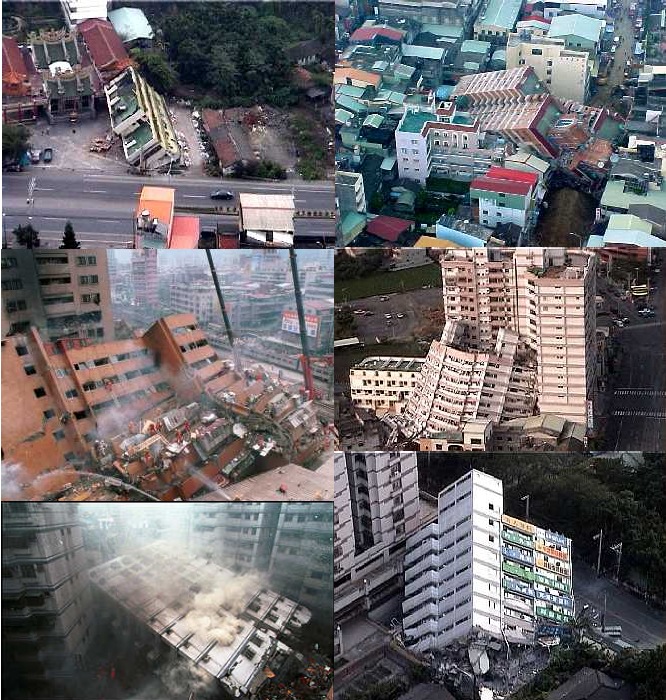
Kobe 1995

But there is another way of looking at it, particularly if we shorten the time scale a bit.  Whether you’re talking about a feudal castle, a one-story hovel, or an early-modern brick train station, most of the structures humans have recently called home are horrendously prone to complete collapse in the face of a serious quake.  The past century has finally seen genuinely successful attempts to achieve some safety from this awesome force of nature.  This isn’t just a matter of buildings, either – we’re also now enmeshed in global networks that allow both communication and direct relief to flow into devastated areas.  This can’t save everyone, but it has already saved tens of thousands in the past few days.  And then there’s education –as the Times poignantly points out, many of the dead in the southeast Asian tsunamis of a few years ago were swept out to sea because they failed to evacuate to safety, even though they had plenty of time.  In Japan, evacuation was not complete, but it was still incredibly effective.

Obviously, we’re still far from secure (either on a day to day basis here in Tokyo, or on the larger scale of society as a whole), and it seems unlikely we ever really will be.  But it also seems undeniable that the large-scale organization of human beings, in an explicitly hierarchical way, has produced huge gains in our collective safety.  It’s also important to point out that this isn’t one of those situations where human beings are struggling to solve a problem that they themselves caused.  Tectonic activity is simply something the earth does, with or without our influence.  And while, all other things aside, the growing density of settlement makes the problem progressively worse, where do you draw that line?  Again, a primitive dwelling is at least as prone to kill its inhabitants as a more ‘civilized’ structure, as the comparison between Japan and Haiti makes tragically clear.

Sendai 2011

I’m sure that anarchists of all stripes have answers for what their ideas would mean for the long-term developments of science, of architecture, of organized education, and of communication and mutual support networks.  (And I don't mean to politicize this in some petty, short-term way - dealing with these real issues is why politics matter in the grandest possible sense, and I can't think of a more important time to talk about them).  But having (at least for now) lived through a true existential threat to one of the world’s great civilizations, I find myself comforted by the embrace of Enlightenment.  Maybe it’s the secular version of a deathbed conversion, but I would not have chosen to face the earthquake in a society less advanced, well-organized, and disciplined than Japan.