Eighty-one years ago today, a Japanese Lieutenant set a dynamite charge on the tracks of a Japanese-controlled railway in Manchuria, in Northern China. The act, blamed on the Chinese, was a successful attempt to initiate sino-Japanese war by the Japanese Kwantung Army. The army had to an extent gone rogue, engaging in militant acts intended to provoke a Chinese response, and was about to be disciplined by the leadership from Tokyo when it chose to take matters into its own hands by manufacturing Chinese resistance. This is known as the Manchurian Incident or the Mukden Incident. What followed was more than a decade of Japanese occupation of and violence against China, including the most brutal single incident in all of World War II, the Rape of Nanking.
Note that I say Nanking was singular in its brutality, not in the number of people it killed. The statistical honors might go to the Holocaust of eastern European Jewry, or to the atomic bombs dropped on Japan by the United States, or maybe even to the firebombing of Dresden by the English. What's remarkable about Nanking, and what it shares with the Mukden incident that paved the way for it, is the completely uncontrolled and undisciplined nature of Japanese military action.
Perhaps this is the real threat Mukden and Nanking hold for Japanese popular imagination, the reason there has yet to be a collective national reconciliation with the legacy of the war, nearly a full century and several generations later - a phenomenon whose very narrow manifestations in popular music I've documented. Perhaps it's not the evil of these acts that's so threatening, but the fact that they are out of character. Certainly, the Germans killed all those Jews, but they did it with a characteristic German efficiency that can be recouped - they may have done something wrong, but they were still German.
Japan's war crimes, though, defied every treasured stereotype of Japanese unity, the concepts so often
propagated, not just in the West but within Japan itself, of a 'hive-like' 'oriental' mentality, of
collectivism, self-sacrifice, and humility. In Mukden, low-ranking officers took it up on themselves to undermine
the plans of their leaders, including implicitly the Emperor. In
Nanking, enlisted men ran wild, raping, pillaging, and murdering in
endlessly creative ways. These were not strong Japanese collective actions gone awry - they were actions deriving from some other root, something alien and awry, something that, whether deeply human or deeply perverse, were surely not 'Japanese.' They cannot be recouped, explained, or folded into a narrative of evolution. For those who believe in the uniqueness of the Japanese spirit, they can only be denied, repressed, dismissed.
Showing posts with label japanese horror. Show all posts
Showing posts with label japanese horror. Show all posts
Tuesday, September 18, 2012

Thursday, June 9, 2011
Japanese Horror-Ween 3: Kazuo Umezu
This is roughly my 200th post at Minds Like Knives - I have several unpublished drafts that Blogger counts as posts, so I can't be quite sure, but since I'm excited about this post (as opposed to the alcohol reviews preceding it) let's call it number 200. Yaaaaaay! Now on to the dismemberment.
Kazuo Umezu is a weird one - not just a weird guy, though he would seem to be that, but a weird career arc, which somehow links into the weird arc of Japanese culture over the last fifty years. His first well-known work, and still considered something of a minor classic, is Nekome Kozo, or Cat-Eyed Boy. It's a spooky but fairly innocent story about a supernatural child who goes around bumping into ghosts and spiders and assorted lighthearted symbols of the weird and scary, in a halloween-childish sort of way. It's honestly not to far from what you'd imagine Miyazaki would come up with if he was contracted to write a "ghost story."
But as time went on, Umezu was given the opportunity - maybe even the impetus - to explore some profoundly dark places. I recently picked up 'Kami no Hidari-te Akuma no Migi-te' ('God's Left Hand, Devil's Right Hand'), and it contains three of the more deeply unnerving stories I've come across this side of Lovecraft. Moreover, these are stories that, if not actually intended for children, maintain (intentionally or not) many of the tropes of children's literature, leaving the adult reader with the impression that they've come across something that quite possibly deserves to be banned or burned - except it's four decades too late.
 This is the first page of 'Kami no Hidari-te.' It requires a little context - you see, this is a nine year old girl getting her eyes gouged out by a pair of scissors from the inside. It turns out this is a dream sequence, but generally Umezu doesn't pussyfoot or dodge the disturbing elements of his stories. Most notably, the second story in 'Kami' begins with the totally unprovoked plot of a group of third graders to brutally murder their teacher so they can "see her true character" after she dies. Child characters prove themselves capable of astonishing violence again and again in this book - sometimes heroic, just as often cruel and malicious. And even the 'heroic' acts are often justified in ways that would get real-world kids locked up - for instance, setting a bear trap in a woman's car because of something seen in a dream.

What elevates 'Kami no Hidari-te' beyond mere shock, though, is the narrative surrealism. In many cases, the conciets are hard to summarize, which in my book is an endorsement. In the first of the three stories, an extended set piece revolves around the idea that 1) a young girl is being possessed by the vengeful spirits of murdered children, 2) the inside of her body has become a battle ground between those children's murderers and the young girl's brother, who is some kind of dream-warrior, and 3) the dead children are ejecting everything from newspapers to tricycles through her into the world, without killing her.

It's gory to an almost mind-numbing extreme, but the plot keeps things moving along and never allows any image to get stale. The same effect holds throughout the book, especially in the third story, which involves the genuinely surreal and delightfully unexplained flexibility of the boundary between dream and reality. The protagonist (the same young boy from the first two stories) at one point enters a dream state, transforms into a crow to kill a spider-queen by ripping her tongue out, and then awakes to spit out the mangled corpse of a spider.
And as I said, what's most insane about all of this is that it relies so heavily on conceits that imply that the intended audience is preteen. The same young boy character (Sou, meaning roughly "idea") is the protagonist of all the stories. His older sister never believes him when he says he's seen something (in a dream or reality, which ultimately become interchangeable), and adults, similarly, seem to distrust something about him. Both of these (like the inarticulate adults of 'Peanuts') seem intended to appeal to actual ten year old boys. Sometimes the kid protagonist is actually right, but then there's also the time that he murders his third-grade teacher, in the real world, without any remorse or consequences.
In short, if it was ever actually intended for children, this is a deeply fucked up book.
 If we're talking about adults, though, it's amazing and highly recommended. This is a recent reprint, with this kickass day-glo cover and a lot of rich and varied partial to full color schemes scattered on the newsprint within. It's a fat book, but even with my middling Japanese it's a pretty quick read (and that's actually another disturbing point, because the simplicity of the language seems to have too-young readers at least partially in mind). Ultimately, if you're sick in the head and enraptured by monsters, death, infestation, mutation, and body trauma, this is an absolute must-have.

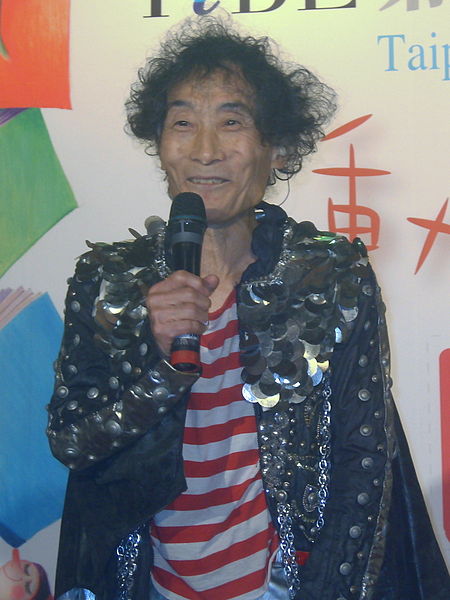 |
| I doubt he dressed like this in the fifties. Or for that matter, the eighties. |
But as time went on, Umezu was given the opportunity - maybe even the impetus - to explore some profoundly dark places. I recently picked up 'Kami no Hidari-te Akuma no Migi-te' ('God's Left Hand, Devil's Right Hand'), and it contains three of the more deeply unnerving stories I've come across this side of Lovecraft. Moreover, these are stories that, if not actually intended for children, maintain (intentionally or not) many of the tropes of children's literature, leaving the adult reader with the impression that they've come across something that quite possibly deserves to be banned or burned - except it's four decades too late.


The grotesque sequences just keep coming, and if you've got a taste for artful shock, they alone will keep you engrossed. For instance, while it's been done to death since (see Stephen King's cockroaches), one might consider these sequences of full-body spider infestation visionary.

It's gory to an almost mind-numbing extreme, but the plot keeps things moving along and never allows any image to get stale. The same effect holds throughout the book, especially in the third story, which involves the genuinely surreal and delightfully unexplained flexibility of the boundary between dream and reality. The protagonist (the same young boy from the first two stories) at one point enters a dream state, transforms into a crow to kill a spider-queen by ripping her tongue out, and then awakes to spit out the mangled corpse of a spider.
And as I said, what's most insane about all of this is that it relies so heavily on conceits that imply that the intended audience is preteen. The same young boy character (Sou, meaning roughly "idea") is the protagonist of all the stories. His older sister never believes him when he says he's seen something (in a dream or reality, which ultimately become interchangeable), and adults, similarly, seem to distrust something about him. Both of these (like the inarticulate adults of 'Peanuts') seem intended to appeal to actual ten year old boys. Sometimes the kid protagonist is actually right, but then there's also the time that he murders his third-grade teacher, in the real world, without any remorse or consequences.
In short, if it was ever actually intended for children, this is a deeply fucked up book.


Tuesday, October 19, 2010
Obakemono thanx
Some fine fellow posting as Quailo over at the Obakemono forums has photoshopped my translations below onto a much better scan from Pink Tentacle. Now that, my friends, is what I call teamwork.


Monday, October 18, 2010
Yokai Autopsy 1: The Blackhair Cutter
As promised, I'm working on translations of Shigeru Mizuki's "Yokai Autopsy" Book. This is really my first time translating anything, so I'm learning as I go, but I'm too much of a writer not to have taken some creative liberties. Also, my apologies for the iffy image quality - I'll be looking for a scanner. In the meantime, you can click through to get a larger version of the image from Flickr.
Here's the first one, the Kurokami Kiri, or "Blackhair Cutter":

(Note: Sorry for the wonky formatting below - I can't figure out how to fix it.)
Opening Text (Top Right): The Blackhair Cutter stealthily chases dark-haired women who travel by night, cutting their hair without ever being noticed. Noone has ever seen the form of the Blackhair Cutter.
Inset: Magnified Diagram of the Black Tongue: Small Prickles emerge from its surface, easily holding on to hair.
Kitaro (Main character of GeGeGe no Kitaro, who appears throughout this book to provide commentary and jokes): "So it's like a trap tongue?"
Inset: The Black Nails: From the center of each finger emerge nails like razors.
Daddy Eyeball (from the cast of Kitaro): "I don't have black hair!"
Inset, Bottom of Right Page: The Blackhair Cutter lives at the edge of drainage ditches.
Rat Man (ditto): "Ditches, eh? He's dirtier than me!"
Anatomy (Clockwise from top left):
Scroll Tongue: Extends quickly to wrap up hair.
Black Brain: A dense organ occupied with trickery and the pursuit of women.
Sleeping Powder Holder: The powder produced here is blown out of the monster's mouth, and he cuts their hair while they sleep.
Black Heart: Pumps hair pigment around the monster's body.
Stomach: The stomach is small and easily filled, so the monster throws away hair that it can't eat.
Hair-Breaking Bowels: The Blackhair Cutter's digestive organ sends the nourishment and pigment from hair to the heart.
Strong Pelvis: The pelvis supports the heavy body.
Pummelling Guts: The guts are called into action to break up the hard-to-digest hair.
Strong Acid Pouch: Produces juice for dissolving hair, which it secretes to the guts.
So, in summary: A yeti-like creature who chloroforms women and eats their hair. I'll refrain for now from digging too deep into the sexual connotations of this construct, or even less the connotations of a Black Brain occupied with trickery and the pursuit of women.
Here's the first one, the Kurokami Kiri, or "Blackhair Cutter":
(Note: Sorry for the wonky formatting below - I can't figure out how to fix it.)
Opening Text (Top Right): The Blackhair Cutter stealthily chases dark-haired women who travel by night, cutting their hair without ever being noticed. Noone has ever seen the form of the Blackhair Cutter.
Inset: Magnified Diagram of the Black Tongue: Small Prickles emerge from its surface, easily holding on to hair.
Kitaro (Main character of GeGeGe no Kitaro, who appears throughout this book to provide commentary and jokes): "So it's like a trap tongue?"
Inset: The Black Nails: From the center of each finger emerge nails like razors.
Daddy Eyeball (from the cast of Kitaro): "I don't have black hair!"
Inset, Bottom of Right Page: The Blackhair Cutter lives at the edge of drainage ditches.
Rat Man (ditto): "Ditches, eh? He's dirtier than me!"
Anatomy (Clockwise from top left):
Scroll Tongue: Extends quickly to wrap up hair.
Black Brain: A dense organ occupied with trickery and the pursuit of women.
Sleeping Powder Holder: The powder produced here is blown out of the monster's mouth, and he cuts their hair while they sleep.
Black Heart: Pumps hair pigment around the monster's body.
Stomach: The stomach is small and easily filled, so the monster throws away hair that it can't eat.
Hair-Breaking Bowels: The Blackhair Cutter's digestive organ sends the nourishment and pigment from hair to the heart.
Strong Pelvis: The pelvis supports the heavy body.
Pummelling Guts: The guts are called into action to break up the hard-to-digest hair.
Strong Acid Pouch: Produces juice for dissolving hair, which it secretes to the guts.
So, in summary: A yeti-like creature who chloroforms women and eats their hair. I'll refrain for now from digging too deep into the sexual connotations of this construct, or even less the connotations of a Black Brain occupied with trickery and the pursuit of women.
Wednesday, October 13, 2010
Japanese Horror-Ween 2: Fuyuko Matsui
Note: I'm now blogging at Blownhorizonz.com. It's more attractive, and it focuses more on cool stuff like noisey music, weird art, and fiction. Check it out!
Fuyuko Matsui (or, in Japanese, Matsui Fuyuko) is a young and fast-rising Japanese artist who produces images that are both explicitly gruesome in a very modern way, and moody, dark, and subtle in the tradition of a certain kind of Japanese ghost story. She is known almost as much for being beautiful and putting a lot of work into self-presentation as she is as an artist - she shows up on the cover of magazines much as would actresses in the U.S. Naturally, her fame is based on drawings of ghost dogs ripping the living flesh from screaming women:


To see even more, including undead snakes, for chrissakes, try her official site as well as this strangely meticulous livejournal entry (do people still use that?).
 I'm really of two minds on Matsui. As a genre fan, her work is mind-blowing - it's smart, meticulous, titillating, and disgusting. It takes you to another world just as effectively as the work of people like Rom Villaseran or Brecht Vandenbrouke (see, you learned about THREE artists today!). But I think that ultimately it's genre work, not Art with a capital DEEP, and the idea that she's some kind of celebrity is a little disquieting. I don't gather that she's really of the Andy Warhol/Lady Gaga school, where her fame is somehow meta-commentary, and it seems unlikely that such gruesome work would form the foundation for fame if she wasn't also a pretty lady. But nonetheless - this is some great work for those of us with morbid minds.
Fuyuko Matsui
(or, in Japanese, Matsui Fuyuko) is a young and fast-rising Japanese artist who produces images that are both explicitly gruesome in a very modern way, and moody, dark, and subtle in the tradition of a certain kind of Japanese ghost story. She is known almost as much for being beautiful and putting a lot of work into self-presentation as she is as an artist - she shows up on the cover of magazines much as would actresses in the U.S. Naturally, her fame is based on drawings of ghost dogs ripping the living flesh from screaming women:


To see even more, including undead snakes, for chrissakes, try her official site as well as this strangely meticulous livejournal entry (do people still use that?).

Sunday, October 10, 2010
Yokai Autopsy! Shigeru Mizuki makes every day Halloween.
Do they know it's Halloween in Japan? You're god damn right they do. Though it doesn't seem as out of control as things tend to be in the States, there are displays of conventional Halloween goods in most every housewares store, and even better, bookstores are featuring the work of Japan's spookiest manga-ka, Shigeru Mizuki. Mizuki might be the most famous manga artist to remain largely unknown in the states - his Gegege no Kitaro has been made into anime every year since it appeared in 1959, and I there's a new live-action film coming out soon (if you've ever complained about constant remakes in the U.S., be thankful you're not Japanese).
Gegege is the story of a ghost-boy who works to defend humans from yokai, traditional Japanese ghosts, goblins, and demons. I've never actually read Gegege, but I found something even better.

The publisher's blurb describes it as a book of "Monster Autopsies," which is exactly what it sounds like - diagrams of internal organs and natural weapons of yokai, along with descriptions of their abilities.

There's no way I was passing this up - there's nothing I love more than a fantasy bestiary. I haven't played Dungeons and Dragons since I was 13, but I could still sit for hours reading through the Monster Manual. And Barlowe's Guide to Extra-Terrestrials was a completely mind-altering experience for me as a kid. There's just something about getting technical with fantastic creatures, providing plausible explanations for their freakiness, that really does it for me. And the yokai Mizuki chronicles are genuinely freaky.
Gegege is the story of a ghost-boy who works to defend humans from yokai, traditional Japanese ghosts, goblins, and demons. I've never actually read Gegege, but I found something even better.
The publisher's blurb describes it as a book of "Monster Autopsies," which is exactly what it sounds like - diagrams of internal organs and natural weapons of yokai, along with descriptions of their abilities.
There's no way I was passing this up - there's nothing I love more than a fantasy bestiary. I haven't played Dungeons and Dragons since I was 13, but I could still sit for hours reading through the Monster Manual. And Barlowe's Guide to Extra-Terrestrials was a completely mind-altering experience for me as a kid. There's just something about getting technical with fantastic creatures, providing plausible explanations for their freakiness, that really does it for me. And the yokai Mizuki chronicles are genuinely freaky.
Subscribe to:
Posts (Atom)