Megane Suupaa (literally, "Glasses Supermarket") is a pretty bland chain of big-box glasses retailers throughout Japan. But this one guy in Shinjuku is semi-famous for pitching their deals on glasses and contacts in the form of high-speed and basically not bad rap. Just another little sign that, while it might not be nearly as dominant as it is in the U.S., hip hop has nonetheless penetrated deeply into the fabric of Japanese life (well, okay, at least urban life).
Friday, July 22, 2011

Wednesday, July 20, 2011
The Least Wu-Tang of All Wu-Tangs: AKB48 and the Bulbous Egg Sac
Credit for the strange title goes to Actionbutton.net, whose review of Darksiders sussed out the idealized features of "Zelda" as a game type, and used that as a rubric for finding Darksiders "particularly Zelda" (though not particularly a good game). I had an apparently similar insight last year when I first started learning about AKB48, a hugely popular pop idol enterprise, who superficially capitalize on a music marketing trick first pursued by the Wu-Tang Clan. AKB, started in 2005, has (yes) 48 members, and they are divided into a series of ranks, grades, and 'teams' which form a variety of sub-groups, fulfill different roles, and appeal to a variety of different fans, all while operating under the same umbrella. This makes AKB48 a many-headed dragon, each head strengthening the constantly-growing body - pretty much in the same way Rae and Ghost would go off and do a couple things, building their own brands and Wu-Tang's all at once.
But AKB48 take everything a step farther. Today was the release date for the first single, "The Extinct Brunette," by NMB48 [warning: don't watch if your faith in humanity is tenuous, it's an unbelievable mess]. Founded just last year, NMB are a parallel AKB, with the same massive, complexly tiered internal structure. While AKB stands for Akihabara, NMB stands for Namba, a section of Osaka. There's also SKE48, started in 2008 and based in Aichi Prefecture. Finally, there's the slight variation of SDN48, with the SDN standing for "Saturday Night" and suggesting the very slightly more adult orientation of that group, composed in part of 'graduates' from AKB (aka women who can no longer pretend to be little girls).
So, with four groups of 48 members each, and numerous smaller formations within each of those, the AKB empire begins to look like a Wu-Tang of Wu-Tangs, as if Killarmy and Sunz of Man had each become a hit factory in its own right. Except, that is, for the part where this Meta-Tang (copyright) is put together by a svengali-like behind-the-scenes producer, Akimoto Yasushi. Wu-Tang negotiated its revolutionary deal as a true group (albeit initially with RZA in a clear leadership role), from a position of little power, and with an eye towards a democratic future in which they could all be equals, without at the same time having to submit entirely to the risks of rule by committee. By contrast, AKB and its spawn were the creation of one man, and every move made can be assumed to have the goal of further enriching him.
You can question a lot of what Wu-Tang have done over the years, but despite the strategic nature of their business arrangements, their music has never been carefully market-conscious. Frankly, they just got really lucky for a few years there, and have since returned to their proper place as vanguardists. The AKB organization, on the other hand, applies the Wu-Tang model to aesthetic, image, and marketing decisions that range from run of the mill pop-machine exploitation to borderline sociopathic mind-fuckery to just remarkably dumb. An instance of the former was the recent introduction of "Aimi Eguchi," a new member who turned out to be a computer amalgamation of five other top members (and whose name was actually a play on the gum she was digitally created to promote). More nefarious, and vastly more fundamental to the AKB plan for domination, is the annual 'election' of the most popular member of the group. This is like a less-democratic version of American Idol, especially since to be able to vote you have to buy a copy of the group's most recent single. There are images floating around of obsessive AKB fans who supposedly bought dozens or hundreds of copies of the single to vote for their favorite member - in other words, the entire scheme aims to exploit some seriously desperate shut-in otaku. (Oh, and for the "just dumb" part? There's an annual intra-group rock paper scissors tournament that takes place AT BUDOKAN).
Of course, as much as it's exploiting the audience, AKB is almost certainly exploiting the girls in the group. Unlike the Wu-Tang, AKB members haven't shown much ability to move into productive solo careers, even as they (Menudo-style) get shuffled out of the main group as they get older. Some go into the older-skewing SDN48, but others take, well, less conventional paths. Most dramatic is Rina Nakanishi, who now works in Adult Video under the pseudonym Yamaguchi Riko. Note, this is not softcore or private sex-tape stuff, but actual hardcore porn starring a former member of the currently most succesful pop group in the country. Of course, the path to that outcome was well paved, since the girls of AKB are trained primarily in dance and dress-up, including donning skimpy clothes for photo shoots, sometimes from a very young age. Not that I'm against half-naked women in principle (or for that matter, totally naked ones), but the unremitting focus on youth is pretty icky - for instance, the video for the new SDN single has them all in schoolgirl outfits, which is standard through the AKEmpire.
Finally, just to reiterate, none of this is anything but a total disaster for Japanese fans or the quality of culture. The core fanbase of socially maladjusted and detached Akiba nerds has resulted in music that would seem to be targeted at children if it weren't for all the overblown synth and sexual innuendo (So, half-deaf, horny children). Ian Martin of the Japan Times makes the apropos comparison to the Korean band Girl's Generation, who while still managed to within an inch of their lives, are also quite clearly being given better music to work with. Pop is pop, no doubt, and maybe America has been spoiled over the past - what, forty-five years? - by the constant availability of some slight counternarrative amidst the pap, whether it was Kate Bush and Blondie cropping up inexplicably in the Eighties or the more recent likes of Justin Timberlake and Lady Gaga (whose music is disposable but who is at least genuinely opinionated, provocative, and let's just say it, gay). What exactly is it that has kept Japanese pop so docile and irrelevant for so long? The more I learn about it, the more I believe it has something to do with the hierarchical nature of the music business . . . and the more I wonder how long this crap can survive the internet, however clever the branding structure.
But AKB48 take everything a step farther. Today was the release date for the first single, "The Extinct Brunette," by NMB48 [warning: don't watch if your faith in humanity is tenuous, it's an unbelievable mess]. Founded just last year, NMB are a parallel AKB, with the same massive, complexly tiered internal structure. While AKB stands for Akihabara, NMB stands for Namba, a section of Osaka. There's also SKE48, started in 2008 and based in Aichi Prefecture. Finally, there's the slight variation of SDN48, with the SDN standing for "Saturday Night" and suggesting the very slightly more adult orientation of that group, composed in part of 'graduates' from AKB (aka women who can no longer pretend to be little girls).
 |
| Akimoto Yasushi, who I hope is proud of himself. |
You can question a lot of what Wu-Tang have done over the years, but despite the strategic nature of their business arrangements, their music has never been carefully market-conscious. Frankly, they just got really lucky for a few years there, and have since returned to their proper place as vanguardists. The AKB organization, on the other hand, applies the Wu-Tang model to aesthetic, image, and marketing decisions that range from run of the mill pop-machine exploitation to borderline sociopathic mind-fuckery to just remarkably dumb. An instance of the former was the recent introduction of "Aimi Eguchi," a new member who turned out to be a computer amalgamation of five other top members (and whose name was actually a play on the gum she was digitally created to promote). More nefarious, and vastly more fundamental to the AKB plan for domination, is the annual 'election' of the most popular member of the group. This is like a less-democratic version of American Idol, especially since to be able to vote you have to buy a copy of the group's most recent single. There are images floating around of obsessive AKB fans who supposedly bought dozens or hundreds of copies of the single to vote for their favorite member - in other words, the entire scheme aims to exploit some seriously desperate shut-in otaku. (Oh, and for the "just dumb" part? There's an annual intra-group rock paper scissors tournament that takes place AT BUDOKAN).
Of course, as much as it's exploiting the audience, AKB is almost certainly exploiting the girls in the group. Unlike the Wu-Tang, AKB members haven't shown much ability to move into productive solo careers, even as they (Menudo-style) get shuffled out of the main group as they get older. Some go into the older-skewing SDN48, but others take, well, less conventional paths. Most dramatic is Rina Nakanishi, who now works in Adult Video under the pseudonym Yamaguchi Riko. Note, this is not softcore or private sex-tape stuff, but actual hardcore porn starring a former member of the currently most succesful pop group in the country. Of course, the path to that outcome was well paved, since the girls of AKB are trained primarily in dance and dress-up, including donning skimpy clothes for photo shoots, sometimes from a very young age. Not that I'm against half-naked women in principle (or for that matter, totally naked ones), but the unremitting focus on youth is pretty icky - for instance, the video for the new SDN single has them all in schoolgirl outfits, which is standard through the AKEmpire.
Finally, just to reiterate, none of this is anything but a total disaster for Japanese fans or the quality of culture. The core fanbase of socially maladjusted and detached Akiba nerds has resulted in music that would seem to be targeted at children if it weren't for all the overblown synth and sexual innuendo (So, half-deaf, horny children). Ian Martin of the Japan Times makes the apropos comparison to the Korean band Girl's Generation, who while still managed to within an inch of their lives, are also quite clearly being given better music to work with. Pop is pop, no doubt, and maybe America has been spoiled over the past - what, forty-five years? - by the constant availability of some slight counternarrative amidst the pap, whether it was Kate Bush and Blondie cropping up inexplicably in the Eighties or the more recent likes of Justin Timberlake and Lady Gaga (whose music is disposable but who is at least genuinely opinionated, provocative, and let's just say it, gay). What exactly is it that has kept Japanese pop so docile and irrelevant for so long? The more I learn about it, the more I believe it has something to do with the hierarchical nature of the music business . . . and the more I wonder how long this crap can survive the internet, however clever the branding structure.
Dipset Trance Party: Witchhouse Without Prejudice
As the kids say I've got this "On Blast," after reading about it way late in the game in a review of AraabMuzik's new album. It's absolutely gold from beginning to end, dark and electronic and hyperactive and grimy/shiny, full of cheap-sounding drums that'll puncture your eardrums.
The greatest/weirdest part, though, is that it basically sounds like the best Witch House compilation imaginable - like what would happen if Salem actually knew what the fuck they were doing, Holy Other lost all that dreary self-reflexivity, and Pictureplane stripped away his melodic hooks in favor of raw chunks of emotive horn stab.
 |
| Dipset Trance Party |
The greatest/weirdest part, though, is that it basically sounds like the best Witch House compilation imaginable - like what would happen if Salem actually knew what the fuck they were doing, Holy Other lost all that dreary self-reflexivity, and Pictureplane stripped away his melodic hooks in favor of raw chunks of emotive horn stab.
Thursday, July 14, 2011
James Blake in Japan: How to Import An Enigma
Update 7/24/2011: A friend told me that the Tokyo radio station J-Wave plays James Blake "all the time." They did, at least at one point - "Limit to your Love" peaked at 47 on the Tokio Hot 100 back in February.
A friend just let me know about the fantastic and fascinating article "Japan in Japan: Notes on an Aspect of the Popular Music Record Industry in Japan," by Toru Mitsui (Popular Music, Vol. 3, Producers and Markets (1983), pp. 107-120). It's a detailed and well-informed description of, first, Japanese labels' practices in the late 1970s and early 1980s with regards to the import of foreign records, and second, of the popularity of the English band Japan in the early 1980s. Though of course not quite current, it's a great window into the subtle processes that can dictate how culture travels between modern societies.
What Mitsui primarily focuses on is the fact that by the 1970s, bidding wars between Japanese labels had made artists already well-known in the West progressively less profitable as higher and higher royalties and advances were promised. This led to Japanese labels more aggressively scouting unknown international talent, who still held a broad appeal for the Japanese market. Particularly interesting to me is that Japan were essentially an art-rock band, but they managed to attract a teenybopper audience in Japan because of their heavily made-up, androgynous image. This audience supported them through three early albums that didn't sell particularly well in England or America. David Sylvian, once a member of Japan, is now one of the leading avant-garde musicians in the West, a position he might not have achieved without the financial support of the Japanese market.
Cases of bands not popular in their home turf succeeding wildly in Japan are so common they've become a cliche. Mitsui cites the early success of Kiss in Japan, and the paradigm case is the band Mr. Big, who are essentially unknown in the West but still tour incessantly in Japan.
More recently, there's the case of James Blake. My general impression is that while he's become quite well known in the U.K., he's definitely a niche product in the U.S., pushed by fringe indie websites like Pitchfork and Gorilla vs. Bear. In Japan, while still not a star, his extremely bleak and fairly abstract album has reached the 70th spot on the Oricon album charts since its release about six weeks ago (I'm really wishing I had a full Oricon subscription right now). According to an interview with Ele-King, his import singles were selling out back in February, the kind of thing that builds great buzz for a domestic release. That qualifies him to represent a sort of indie/underground version of the more thoroughly dominant, but also clearly more straightforwardly marketable, likes of Kiss and Mr. Big.
It's not entirely clear why or how this happened. He's backed here by the Universal International label, but there aren't overwhelming signs of where that power is going. He's had prominent listening station placement in Tower Shibuya, but that's not something that requires a major label's backing. He was recently featured on the cover of Sound and Recording magazine, a very prominent magazine but hardly directed at the masses of people buying records. It's hard to argue that the music itself is in tune with the "Japanese market" as a whole, since that's overrun with a pestilence of throwaway pop that seems, at least superficially, to be satisfying public demand.
This may have been one moment of a trend I would like to substantiate. What if, as the music industry as a whole declines (and it is declining in Japan, albeit more slowly than in the U.S.), artists who people are more deeply invested in decline less steeply than more disposable pop? What if owning an album like "James Blake" is more intimately tied up with identity creation than owning an AKB48 record? And of course, that's where my little hypothesis breaks down, because it's undeniable that the otaku gain a great deal of identity from their purchase (sometimes en masse) of AKB records and merchandise. The fact that it is inherently less valuable and interesting than James Blake, that these people are building their identities on sand, doesn't seem to make their activities any less persistent over time. In that context, the question shifts - we have to ask not, "What made this strange James Blake record successful?" but the rather more depressing, "What kept this excellent James Blake record from being a much, much bigger success?"
A friend just let me know about the fantastic and fascinating article "Japan in Japan: Notes on an Aspect of the Popular Music Record Industry in Japan," by Toru Mitsui (Popular Music, Vol. 3, Producers and Markets (1983), pp. 107-120). It's a detailed and well-informed description of, first, Japanese labels' practices in the late 1970s and early 1980s with regards to the import of foreign records, and second, of the popularity of the English band Japan in the early 1980s. Though of course not quite current, it's a great window into the subtle processes that can dictate how culture travels between modern societies.
What Mitsui primarily focuses on is the fact that by the 1970s, bidding wars between Japanese labels had made artists already well-known in the West progressively less profitable as higher and higher royalties and advances were promised. This led to Japanese labels more aggressively scouting unknown international talent, who still held a broad appeal for the Japanese market. Particularly interesting to me is that Japan were essentially an art-rock band, but they managed to attract a teenybopper audience in Japan because of their heavily made-up, androgynous image. This audience supported them through three early albums that didn't sell particularly well in England or America. David Sylvian, once a member of Japan, is now one of the leading avant-garde musicians in the West, a position he might not have achieved without the financial support of the Japanese market.
Cases of bands not popular in their home turf succeeding wildly in Japan are so common they've become a cliche. Mitsui cites the early success of Kiss in Japan, and the paradigm case is the band Mr. Big, who are essentially unknown in the West but still tour incessantly in Japan.
More recently, there's the case of James Blake. My general impression is that while he's become quite well known in the U.K., he's definitely a niche product in the U.S., pushed by fringe indie websites like Pitchfork and Gorilla vs. Bear. In Japan, while still not a star, his extremely bleak and fairly abstract album has reached the 70th spot on the Oricon album charts since its release about six weeks ago (I'm really wishing I had a full Oricon subscription right now). According to an interview with Ele-King, his import singles were selling out back in February, the kind of thing that builds great buzz for a domestic release. That qualifies him to represent a sort of indie/underground version of the more thoroughly dominant, but also clearly more straightforwardly marketable, likes of Kiss and Mr. Big.
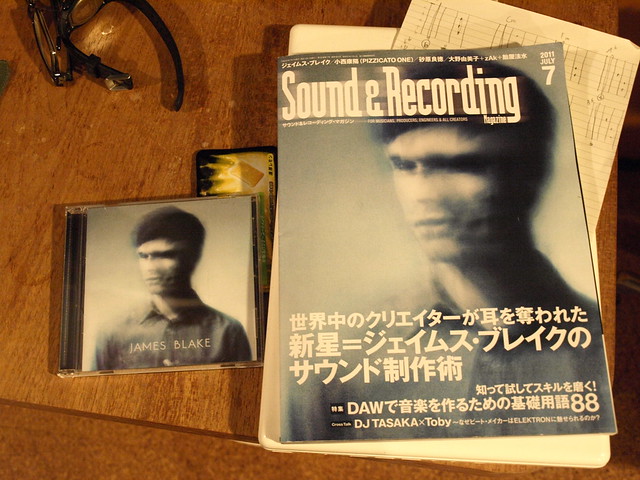 |
| Courtesy Kishimen |
It's not entirely clear why or how this happened. He's backed here by the Universal International label, but there aren't overwhelming signs of where that power is going. He's had prominent listening station placement in Tower Shibuya, but that's not something that requires a major label's backing. He was recently featured on the cover of Sound and Recording magazine, a very prominent magazine but hardly directed at the masses of people buying records. It's hard to argue that the music itself is in tune with the "Japanese market" as a whole, since that's overrun with a pestilence of throwaway pop that seems, at least superficially, to be satisfying public demand.
This may have been one moment of a trend I would like to substantiate. What if, as the music industry as a whole declines (and it is declining in Japan, albeit more slowly than in the U.S.), artists who people are more deeply invested in decline less steeply than more disposable pop? What if owning an album like "James Blake" is more intimately tied up with identity creation than owning an AKB48 record? And of course, that's where my little hypothesis breaks down, because it's undeniable that the otaku gain a great deal of identity from their purchase (sometimes en masse) of AKB records and merchandise. The fact that it is inherently less valuable and interesting than James Blake, that these people are building their identities on sand, doesn't seem to make their activities any less persistent over time. In that context, the question shifts - we have to ask not, "What made this strange James Blake record successful?" but the rather more depressing, "What kept this excellent James Blake record from being a much, much bigger success?"
Sunday, July 3, 2011
Red Bandana Lab, Ochiai Soup, 7/2/2011
Had a really fantastic time Saturday at Soup, normally a home for experimental music, this time more focused on political messages and satire. The first act was a Ukelele/drag singer. The prominence of broad drag on the Japanese radical left is something I've only just really noticed, and I haven't quite processed it. It's particularly interesting because the same scene is home to a higher-than-normal concentration of transgendered people. It was a lot of fun and in good humor, but still I wonder how those in the audience (a couple) felt about seeing this:

The main attraction was Red Bandana Lab, who I knew from their appearances at numerous sound demos going back years. They really blew me away, both with their otherworldly track selections and MC Yuso's furious styles.

The event attracted a huge swath of Tokyo's radical left.

Kei of Irregular Rhythm Asylum

Taku from Shirouto no Ran

Photographer Goso Tominaga. I wrote a mini-essay for a book of his pictures coming out sometime in the fall.
In conclusion, stay away from awamori, that stuff is dangerous.
The main attraction was Red Bandana Lab, who I knew from their appearances at numerous sound demos going back years. They really blew me away, both with their otherworldly track selections and MC Yuso's furious styles.
The event attracted a huge swath of Tokyo's radical left.
Kei of Irregular Rhythm Asylum
Taku from Shirouto no Ran
Photographer Goso Tominaga. I wrote a mini-essay for a book of his pictures coming out sometime in the fall.
In conclusion, stay away from awamori, that stuff is dangerous.
Event Announcement: Understanding (and improving) Independent Music in Japan
From The Ground Up: Possibilities and Obstacles for Independents in the Japanese Music Industry
A conversation with Hiroki Sakaida of Pop Group Records
Toukyou Geijitsu Daigaku (Geidai), Kitasenju Campus, Lecture Room 1, 18:30-20:00, Tuesday January 12th

[I've put together a fairly informal event for next week, and I sincerely hope you can attend. Information follows.]
In 2005 Hiroki Sakaida independently produced and released “Kaikoo,” a DVD chronicling the activities of a group of hip hop and electronic artists in Tokyo. Building on the huge success of that release, he founded Pop Group records, which has become the home to a wide variety of artists, from hip hop to punk rock and R & B. Pop Group’s aim and philosophy is to introduce innovative artists with an exploratory spirit into the Japanese mainstream. With an entrepreneurial ethos and constant eye for new channels that can carry the label’s message, Sakaida has grown the business consistently over the last five years, including establishing the annual Kaikoo festival.
However, considerable obstacles face efforts to operate outside the traditional channels of the Japanese music business. Many independent artists perceive an “indie glass ceiling,” a limit to success due largely to the cozy relationships between mass channels, such as television, and powerful artist management companies and large labels. Independent labels such as Zankyou and Rose that have launched the careers of successful artists, but such cases seem comparatively rarer than in, for example, the post-Nirvana U.S. music market, where the route from indie to major is more well-worn.
In an informal conversation format, Sakaida will discuss his experience founding and expanding an independent label in Japan, and consider how infrastructure, policy, and culture have impacted his efforts to champion new aesthetics. We will attempt to draw lessons from his experience about what changes to these conditions, if any, might make it easier to foster and spread adventurous Japanese popular music.
The conversation will be in Japanese, with English translation available as needed.
Saturday, July 2, 2011
Sleep of Ages - Hercules Against the Moon
Sleep of Ages - Hercules Against the Moon-Men by Sleep Of Ages
I've been trawling Soundcloud (or is that trolling?) while I do a last mad set of JLPT drilling. This track in particular jumped out at me. Of course, if you're not into noise, it's unlikely to connect, so enter at your own risk.
I've been trawling Soundcloud (or is that trolling?) while I do a last mad set of JLPT drilling. This track in particular jumped out at me. Of course, if you're not into noise, it's unlikely to connect, so enter at your own risk.
Subscribe to:
Posts (Atom)